Sunday, 5 April 2015

ANTIQUING IN AREZZO - THIS FAMOUS MONTHLY MARKET IS A MUST

It's becoming a habit that we plan our visits to Umbria so they coincide with the first Sunday in the month because that's when the famous antiques market is held in Arezzo which is about an hours drive from our apartment in Citta. We've been several times now and on this trip we had double bubble - Easter weekend in our apartment combined with a trip to the antiques market on Easter Saturday.

Easter Saturday morning meant an early rising at 6am so we could set off and be at the market by 8.30am - not so much to Jon's liking, but he's learned to accept my philosophy that "the early bird gets the worm". We chuckled later on that morning when the telefonino beeped and we got a text from one of our friends out here saying "Are you boys heading out to the Arezzo fair today cos' I'd like to hook up with you if you are." By this time we'd done the fair, had coffee and croissants and were half way to Pienza for lunch, so I had to text back and tell her we'd been and gone. "But it doesn't start till 10am" she texted back and I had to text again to tell her that those in the know would realize that a lot of the buying and selling of the fresh stock had probably been done by the stall holders the night before!!

We drove to Arezzo up the A1 motorway a couple of junctions and duly paid our 3.70 euros toll before taking the main road in to town. There are prettier routes but they are much slower and when you are chasing the bargains they are not the best options. Approaching this city of 100,000 people from this direction, especially for the first time, is slightly off putting as there are miles of sprawl to be encountered with the usual shopping malls, industrial estates and car dealerships lining the
roadway and as I write this the thought that this is another form of "black pathway" enters my head (see previous posting). But don't be put off - if you make the journey what lies ahead is a jewel well worth waiting for.

Aerial View of Arezzo, Tuscany
Arezzo is a city and commune in the province of Tuscany 50 miles SE of Florence and it grew up on a steepish hillside site above the floodplain of the River Arno. It has a long history dating back to Etruscan times when it was an important urban centre and it was also significant to the Romans as a military station on the Via Cassia. Later it would become an episcopal seat and an independent city state between 1098 and 1384 when it was finally conquered by the Florentines who annexed it and make it part of the Grand Duchy of Tuscany. During later centuries, after the medieval period, it experienced a period of economic decline and this is one of the reasons why it has such a well preserved medieval old town, despite later additions. It's only in the 20th century that modern development has produced the urban sprawl already noted, but that's easily forgotten when the "centro historico" is reached.

If arriving by car its a good idea to follow the signs for the "petrie" car park which lies behind the cathedral and the old town. Here parking is easy and there's an interesting walkway which involves entering the town through the old medieval walls. Part of this experience involves taking a series of escalators which help with the steep climb and this is something I've come across in several Italian towns (Perugia being a good example) and when you are getting older you can't help being appreciative of the thoughtfulness of the commune authorities. I'm glad to say the environmental impact seems minimal. As you ascend some of the covered moving staircases the walls are decorated with well painted murals of ferocious looking armoured and helmeted knights on horseback and with vibrant sets of colours to their clothing. After our first visit I later discovered this was a reference to the famous "GLOSTRA DEI SARACINO" an annual event dating back to medieval times where knighted men wearing colours representing different fraternities relating in different parts of town, competitively charge at a target pinned to a carving of a Saracen king and accumulate points for their accuracy. It's all highly competitive and evidently the whole of the old town is full of folk in medieval dress for the event. https://youtu.be/EB1PEu30Qws

A Knight spears the target at the annual Glostra dei Saracino in Arezzo
Through the gate is the tourist office on the left and then there's a passageway which brings you directly in to the piazza in front of the cathedral and also not far from here is the remains of the old Medici fortress constructed after  Arezzo had become part of the Grand Duchy of Tuscany; just a few minutes further down the hill is the Piazza Grande - one of the finest medieval squares anywhere in Italy.

Piazza Grande - Arezzo
The photograph shows just one side of the medieval square and on the left is the columned apse of the 13th century Romanesque church of Santa Maria della Pieve which also has a spectacular massive square bell tower.

There are many famous names associated with Arezzo including the renowned Piero della Francesca who painted in the 15th century the world famous fresco cycle - "the miracle of the true cross" in the church of San Francesco and Arezzo was also the birthplace of Giorgio Vasari, architect, painter, historian and writer, who famously produced one of Europe's first art history books "Artist's Lives" in 1550. The loggia on the north side of the Piazza Grande is by Vasari and here there is a commemorative plaque to Arezzo's most famous son.
Monument to Giorgio Vasari (1511-1574) in Piazza Grande
The Piazza Grande and the narrow streets and squares surrounding it, including the cathedral Piazza, is every month home to Italy's most famous antiques market. Wander the streets and you will come across stalls belonging to up to 500 dealers selling everything from tatty old "shabby chic" furniture to jewellery, ceramics, glass, textiles, old tools, second hand books and prints and just about any other sort of old junk you can think of. The fair was started in 1968 by a local antique dealer and collector called Ivan Bruschi and it was the first of its kind in Italy. Since then its flourished in to probably the best known antiques market in Italy and upwards of 20,000 visitors come here every month to browse and buy and generally soak up the atmosphere of this lively and stimulating event. As well as the stalls there are approximately a further 100 permanent dealers with shops in the vicinity, again selling a variety of stock, many of them with specialist interests and a number focussing on interior design. Some of these are very up market! I like nothing better than to absorb myself in the stalls round the streets of the Piazza Grande and I've come to know one or two dealers whose stock I like to look over and purchase from when we go. There's one kindly lady near the cathedral who has a general stall where, on the wall opposite her pitch, she has boxes of old framed pictures done in a variety of media. Some of them are truly terrible, but sometimes there are a few that are not half bad and already the walls of our Citta apartment are adorned with "original" works of art from her stall including still lifes, landscapes and even a portrait or two. The costs are incredibly modest, 20 to 30 euros is the norm, and this wouldn't even be the price of getting a small picture framed these days. But, as with flea markets the world over, one has to be wary at events like these and its wise to remember the old adage "a fool and his money are easily parted".
Stalls in the square next to the Vasari Loggia - Piazza Grande
Dealers these days, in London, Paris or here in Italy, find it harder and harder to get decent quality stock at good prices and fairs like the Arezzo one are not the treasure troves that perhaps they once were 20 years ago. Arezzo is as much a tourist event these days as it is a dealer's fair. There is an awful lot of reproduction material for sale here (just as there is now in the Portobello Road in London) much of it imported from the far east and a lot of it with a distressed look to appear old; the unwary can easily be deceived. The message is to be careful. Consider the prices being asked and if you know something is a good buy then go ahead. Similarly, if you are looking for decorative pieces, there are loads of bargains to be had in Arezzo which are often cheaper than the prices that you would pay in a shop. Talk and chat with the dealers and form your own opinion and haggle over the price. It's best to go home and be delighted with what you have purchased than to have to repent at leisure.
Examining an object on a dealer's stall
And I know what you are wanting to ask now. What did I purchase on this particular trip? Well - it was a modest spend this time round. I spent 20 euros on a large, rather dark, still life painting from my usual stall - I still haven't got round to cleaning it and putting it on the wall. I also bought a small ebony oval shaped ladies' nail buffer in a charming leatherette case with its original price written in ink on the bottom. It dates from the elegant belle epoque period of the early 20th century and its a charming little collectable. It cost 5 euros.That was it - 25 euros in total. Was I disappointed?- I would never say that and we have no regrets about spending our day there. If the fair was weekly and I lived here all the time I would be there every Saturday - (not sure about Jon though - I somehow doubt he would show the same enthusiqasm)!!


Oh - I discovered later in the day that our friend Elin had turned up at the fair and bought a dated 1957 brass tuba which she haggled down from 120 euros to 80 to give to her fiance's son who is learning to play brass instruments back home in Canada. At dinner that evening she refused the invitation to appear here so this is me attempting to give it a blast!!!
Me playing the tuba found
 at the Arezzo antiques market in April 2015

KBO - IAN

WHEN IS THE FAIR?
The fair is held in the old town of Arezzo every first Sunday of the month and the Saturday before.


HOW TO GET THERE?
By train - most of the stopping trains between Florence and Rome and vice versa call at Arezzo. the old town is a 10 minute walk from the station.

By road - take the Arezzo junction from the A1 toll motorway between Florence and Rome and its a 15 minute drive to the car park identified in the text. Google maps will help you find the Pietri car park.

THE SARACEN JOUST
This takes place every year on the last Saturday in June in the evening and on the first Sunday in September in the afternoon. Tickets are necessary. You can see it "in action" on U tube! Check the web site.

Sunday, 29 March 2015

THE SEASON OF GROWTH & RENEWAL - "PRIMAVERA" or "AN ALLEGORY OF SPRING" BY BOTTICELLI


THE SEASON OF GROWTH & RENEWAL - "PRIMAVERA" or "AN ALLEGORY OF SPRING"
By Sandro Botticelli - c1482

After the dark days and bleak weather of a Winter in the northern hemisphere it's always a pleasure to see the first signs of spring - the season of new life and renewal. It might be the first snowdrops in a town garden, catkins on willow shrubs in a country hedgerow or lambs in a farmer's field and who would own up to not remembering growing horsechestnut "sticky buds" in vases on the primary school window sill? A pleasant memory from boyhood returns as I write this posting - a recollection of going out on a fresh March day with fishing net and jam jar to Johnny's Pond near where I lived in Skipton to find the first frog spawn of the new year, bringing it home and setting up a tank to watch it metamorphose in to tadpoles and then tiny frogs in just a matter of weeks. As a young man, whilst a Biology major at University, I also remember writing an essay entitled "The whole of nature is based on cycles - discuss" and evolutionary adaptation to changing seasonal conditions was one of the themes I became absorbed in. On yet another level I also find it fascinating to reflect on the notion that Christ's life is purported to have begun with the immaculate conception in spring and ended with the crucifixion and resurrection at the same time of year - Easter being the most important festival in the Christian church.

Not surprisingly the subject of the changing seasons and the importance of spring has been an endless source of inspiration for artists and their patrons for centuries and this was indeed the case during the Italian Renaissance, particularly in the late 15th century. My choice of painting for this particular posting, one of the best known paintings in the Uffizi Gallery in Florence, explores the subject of "Spring" in a challenging way that has proved controversial to art historians in the 20th century, though it was not given the title "Primavera" until the middle of the the 16th century by GiorgioVasari - the author of "Artist's Lives".

"PRIMAVERA" by Sandro Botticelli - c1482
At just over six feet wide by three feet tall it's large and takes the form of a horizontal oblong. It's a colourful tempera (1) painting on panel presenting a complex arrangement of figures in an orange grove setting. The identification of the figures and the precise significance of their inter-relationship has been argued about and debated for decades, so what I am presenting here is the gist of what is accepted by many art historians to be the essence of the picture. So let's have a look at it in a bit more detail.

As mentioned earlier the setting is an orange grove - and traditionally orange trees have been associated with the powerful and influential Medici family. The picture was probably commissioned by Medici family member Lorenzo di Pierfranceso dei Medici, a distant cousin of Lorenzo the Magnificent and a friend of Marsilio Ficino, the founder of  Neo-Platonic philosophy popular with the Florentine intelligentsia in the late 15th century. The picture appears to have been destined for his marital bedchamber at Villa Castello just outside Florence and it was in this house that Giorgio Vasari saw it in 1550 and entitled it "La Primavera".

Another fascinating feature of the painting's composition is the foreground which shows a grassy area covered in a multitude of colourful wild flowers - a sure sign of spring. One recent study has established there are approaching 200 different plant species visible and so accurate is Botticelli's depiction of them that over 130 of them have been identified and named!

A distinctive aspect of the painting's composition is its lack of depth; there is no attempt by the artist to introduce the clever single point perspective developed by Brunelleschi. All of the figures are set close to the picture plane (imagine that as the glass in a picture frame) and this creates a feeling of flatness in the composition. This in turn gives the impression of a classical frieze where the figures are involved in an unfolding story. On another level the painting looks rather like a northern European Flemish tapestry of the period. These were highly valued by the Florentine elite at the time.

Taking that idea of a classical frieze a stage further, it's been suggested the best way to interpret the painting is to read it from right to left so we will begin there.

ZEPHYR PURSUING CHLORIS 
The darkened figure of a winged youth on the far right is thought to be Zephyrus, God of the West Wind and we can see him lustily in pursuit of a beautiful and scantily clad Chloris - a wood nymph; after raping her he will ultimately name her his wife. As Chloris attempts to escape Zephyr's advances his warm breath from puffed cheeks causes flowers and leaves to sprout from her mouth and she begins the transformation in to Flora, goddess of Spring. The next figure is the metamorphosed figure of Chloris as Flora wearing a beautiful floral patterned gown and garlands and scattering flowers on the woodland floor. As with many Renaissance paintings with a classical rather than a religous theme, the sources and inspiration for them come from literature - both classical and contemporary. Here the classical source appears to be the 5th book of Roman poet and scholar Ovid's Fasti where he describes the story of Zephyr and Chloris and her transformation in to the goddess Flora. Lucretius's poem "De rerum natura" also recounts a tale of Spring involving Venus, Cupid, Zephyr and Flora. The story was taken up by a humanist scholar, poet and tutor to the Medici family children, one Angelo Poliziano (1454-94) who wrote a poem which included the line "I was Chloris who am now called Flora" which emphasizes the before and after aspects of the story.

ZEPHYR, AND CHLORIS & THE METAMORPHOSED FLORA
- GODDESS OF SPRING
In the centre of the painting the goddess Venus presides over the orange grove carefully positioned in an arched break in the trees with myrtle shrubs behind - an attribute of the goddess. By looking in the opposite direction to the earthy, carnal encounter involving Zephyr and Chloris she appears to be favouring a purer, sweeter form of love being enacted to her right. Her companions, the three Graces, daughters of Zeus, dance as a trio in celebration of the arrival of spring. Above Venus's head is her mischievous blindfolded son, Cupid who fires off an arrow in the direction of the graces. One of them, with her back towards us, appears smitten with the handsome, scantily clad figure of a young man who has been identified as Mercury, the god of springtime whose role was to defend the garden from intruders. (Interestingly, its been suggested that Lorenzo di Pierfrancesco is the model for Mercury). The grace to her left appears to have recognized the emotion on her sister's face and Venus seems to raise a hand of approval of what has happened. It's all a contrast to the earthy scene being played out on her opposite side.
THE THREE GRACES & MERCURY
Art historians have had a field day trying to interpret the intellectual significance of the painting and contrasting points of view have emerged. In addition to its obvious meanings its been proposed that the painting, in the spirit of teaching life's lessons through allegory and myth, represents a view of Neoplatonic ideas about the human emotion of "love" which would have appealed to members of the progressive Medici. Attempting to bring together Christian values and classical philosophical ideas Venus is set in the role of overseeing all matters to do with earthly and divine love. This resonates also with the neoplatonic idea of the goddess being the classical equivalent of the Virgin Mary. Certainly there appear to be references to this in the painting's composition where the goddess is framed in an almost religous arch like setting with hand raised in what seems like a benediction or blessing.

Mythological paintings like this one were innovatory in late 15th century Florence and were an alternative to traditional religous subjects. To families like the Medici they provided intellectual, stimulion as well as an erotic charge as can be seen here. For Sandro Botticelli there was little in the way of precedent to work with - all of his work had been of a religous nature up until the time his talents came to the attention of members of the Medici family. Whatever the intellectual meanings implicit in this painting, however, I take pleasure in its detail - the way the artist deals, for example, with the effects of air movement on delicate fabrics and drapery is spectacular and I am drawn to investigate further the identified species of flowers visible in this Renaissance garden.

Since 1919 the painting has hung in the Uffizi Gallery in Florence and having darkened over a long period of time it was restored in 1982. It is of course shown in a multitude of art history text books, but I can't wait to see it again on my next visit to Florence. As I write this posting for April, Easter is just a week away and next Wednesday we fly to Pisa so I'm looking forward to experiencing an Umbrian spring for the first time. I haven't decided what to write about for the month of May yet, but hopefully I'll get some inspiration during our week away.

(1) Tempera was the popular medium for painting on gesso covered wooden panels in Florence in the late 15th century only being superceded by oil at the time of the new century. Essentially it involved mixing ground pigments with water and a binding medium which was usually egg yolk. As it was fast drying the paint had to be applied quickly and none of the subtleties possible with oil were possible but the end results were permanent, colourful and impressive and have survived well.

Sandro Botticelli (c.1445-1510)
Christened Alessandro di Mariano Filipeppi in his home city of Florence he was the son of a tanner. Botticelli is a nickname, probably given to him by his elder brother and means "small wine cask" in Italian. He was a pupil of the renowned Florentine painter Fra Filippo Lippi and enjoyed many commissions in Florence, the most important for members of the Medici family in the 1480's. In 1481/2 he travelled to Rome to undertake work on frescos in the Sistine Chapel. Following the death of Lorenzo in 1491 and the rise to prominence of Girolamo Savonarola, vicar-general of the Dominicans, Botticelli's work became once again more sober in its nature and intent. He died in 1510, unmarried, in Florence and was buried in the church of the Ognissanti.

KBO - IAN


Tuesday, 10 March 2015

A TUSCAN "WHODUNNIT" BY MICHELE GIUTTARI - A FORMER FLORENTINE POLICE CHIEF

I've written in the past about the series of themed detective novels set in Florence I've enjoyed reading whilst on holiday in Italy. On Christmas Eve in Rome I was wandering round a bookshop in one of the gallerias on the Via del Corso and came across a another title in the series by the acclaimed author Michele Giuttari  - 'The Black Rose of Florence'. I was pleased it was available in English, though it would have been better to take the challenge of reading it in Italian. On the other hand that would have made for a very slow read and there is little doubt I would have still been reading it next Christmas! As with the others I'd read by this ex Florence police chief turned author, it proved to be another page turner and this time the occult theme was both edgy and fascinating and the author exploited it effectively via a tight narrative set in the heart of Florence and the hills surrounding it. I hardly put it down until I'd finished it and it was perfect light reading for the quiet days between Christmas and New Year. I've just discovered that Giuttari has published a new novel entitled 'Death Under a Tuscan Sun' (Little Brown - £14.99) so its now top of my non-fiction list and it will no doubt be my book of choice for our Easter break in Umbria.

Michele Giuttari
What makes Giuttari's books so interesting is the inspiration he draws from  his personal experience as a police officer in a career which lasted over thirty years; he finally retired from the Italian force in 2010 and he now lives with his German wife in her home country in the middle of a forest which he says is good for his writing!

A Sicilian by birth Giuttari joined the Italian police force in 1978 and went on to work in Calabria, Naples and more recently Florence. His posting to the regional capital of Tuscany came about as a result of the 1993 city centre car bombing there which killed 6 people, injured 26 and destroyed a number of paintings in the Uffizi art gallery - an act which was part of a series of bombings in Italian cities instigated by the Mafia as a result of newly introduced tough prison conditions for convicted Mafiosi. He went on to work on a  number of high profile cases including the notorious "Monster of Florence" case which had involved the mysterious death of eight couples in the Tuscan countryside round the city between 1968 and 1985 - all of them shot with the same Beretta pistol and the women's bodies mutilated. Giuttari's re-opening of the case in the mid 90's and which investigated the murders as the work of a group of killers  rather than of a single murderer, led to arrests additional to the man serving a prison sentence for the killings. This led to much publicity at the time, but the case was never fully resolved and that has remained the situation up to this day causing Giuttari much frustration and leading him to make comments about case blocking by "powerful untouchables" with vested interests, remarks which have cost him dearly at a career level and personally in recent years.

When interviewed by Giulia Rhodes, a Daily Express journalist, for an an article which appeared in the paper at the beginning of March, Giuttari admitted that his fictional detective who appears in all his novels, Chief Michele Ferrara, is him. He told the journalist that they have become closer and closer as time has gone by, until in the latest book their characters overlap entirely, commenting "He develops investigations in the way I did. It is a real method and one which makes the policeman the real driver of the case. Man must be at the centre of the investigative work not science, with his professional experience and his intuitions. Though forensic input is important we must continue to rely on the classic tested methods of gathering evidence and respect the timescales of an investigation" - he told the journalist.


In the series of novels Chief Ferrara comes across as something of a likeable loner, but as a leader respected by his staff and a man loved by his wife and close friends. He is determined, thorough, curious and zealot-like in his quest for justice and he brings all these qualities to bear in the myriad of cases he investigates in the books, which involve theft, drugs, blackmail, extortion, prostitution, murder and every other vice and crime you can think of - and mostly set in the captivating city of Florence and the Tuscan countryside round it. It's all a far cry from the idyllic Elizabeth Mayes view of Tuscany however, so be prepared for the horrors associated with the darker side of Italy and contemporary human life in it. The latest novel evidently revolves round the escape of a desperate serial killer from prison and the murder of a number of women which follow in a hot Florentine summer. The reviews are good so I'm looking forward to a good read soon! Enjoy.

KBO - Ian


Saturday, 28 February 2015

A PAIR OF ITALIAN BRONZES RECENTLY ATTRIBUTED TO MICHELANGELO BUONAROTTI - IAN COX's ITALIAN ART OBJECT OF THE MONTH - MARCH 2015

OBJECT IN FOCUS - MARCH 2015

A PAIR OF RENAISSANCE BRONZES OF MEN MOUNTED ON PANTHERS - ONLY RECENTLY ATTRIBUTED TO MICHELANGELO.

Recently a pair of amazing bronze sculptures have gone on display at the Fitzwilliam Museum in Cambridge which have caused a major stir in the art world and I have been drawn to tell the story of them in my choice of Italian art object for March.

I've always been an admirer of sculpture and my earliest memories of going to museum exhibitions focused on this type of art work. I must have been about seventeen when I made my first expedition to the British Museum in London (a big thing for a young lad from Yorkshire) and it was to see the "Treasures of Tutenkhamun" where many of the objects were essentially pieces of Egyptian sculpture. I remember being amazed by what I saw and I am sure it was this exhibit that ignited my interests in the fine arts for the first time. I still have the companion book to that exhibition in my library. But what is it about sculpture that makes it so arresting compared with other types of art work? I believe it's to do with its three dimensional nature; somehow we as viewers can relate and respond to its directness in a positive way and not only can it be incredibly beautiful and moving, it can also inform and challenge almost every aspect of our beliefs and thinking. It's an art form which communicates the essence of humanity and I'm a sucker for it. Whenever I'm on my travels I try to search for places where I can see it - in public spaces, adorning buildings, inside them and in museum contexts too. In the depths of the recent British Winter it was a pleasure one day to read in the press that the Fitzwilliam Museum had put on display a pair of bronzes which had recently been attributed  to "il divino"  - the Renaissance master sculptor Michelangelo - and I just had to go and see them.

Michelangelo Buonarotti (1475-1564)
The great Renaissance artist Michelangelo (1475-1564) was involved with making sculpture throughout his long career and in many ways it was the thing that from an early age he loved doing most - despite his incredible achievements in architecture, drawing and painting. He wrote in one his many poems of how sculpture could bring, through the artist's creativity, inspiration and craftsmanship, "life" to inert materials:

"Sculpture, the first of the arts, delights a taste
Still strong and sound; each limb, each bone, 
Are given a life and, lo, man's body is raised
Breathing alive, in wax or clay or stone."

Many people are familiar with Michelangelo's monumental works in marble and especially objects such as the larger than life figural Medici Tomb sculptures in Florence, the fantastically moving "Pieta" in St. Peter's Basilica in the Vatican and the iconic Carrara marble statue of David, now in Florence's Accademia Museum, which has to be one of the world's best known art objects through the many reproductions and derived tourist souvenirs which grace the shelves and mantelpieces of houses and apartments all over the planet. Writing this has just reminded me of my art historian friend who has a plastic table lamp of David's head which he bought in a shop in the Lanes in Brighton a few years ago! Fewer know that Michelangelo also worked in bronze throughout his career and this is due to the fact that until recently there were no known pieces by him in this medium that have survived through to the present day. It's known from documented and other sources for example, that he made a two thirds life size figure of the "David" sculpture in bronze for a French aristocrat which disappeared during the French Revolution and that he sculpted a twice life size figure of Pope Julius II which was melted down to make artillery just three years after it was cast. This is why the Fitzwilliam bronzes have created a storm for recently a group of distinguished academics have concluded that the pair of male figures mounted on panthers shown below were sculpted by Michelangelo in the early 16th century.

The Rothschild Bronzes of Men mounted on Panthers
currently on display at the Fitzwilliam Museum, Cambridge until August 9th 2015
Standing almost three feet tall the sculptures are a non-matched pair of muscular, naked alpha males  mounted on ferocious looking panthers - inspired by the idea of mounted figures from a bacchic procession. The figure on the left is of an older man, the one on the right a younger, virile looking figure. Both have one arm raised above their heads in triumphant gesture.

The history of the figures is interesting so I will start with that. The figures are known as the Rothschild bronzes, named after their first recorded owner, Baron Adolphe de Rothschild, a close descendant of the Rothschild banking dynasty founder. A document dated 1878 is the first known record of ownership and at the time they were attributed to Michelangelo. There are some indications they might have been bought from one of the Bourbon Kings of Naples and they may have come from the Villa Reale at Caserta where the Bourbon collections were shown. When Baron Adolphe died in 1900 they passed in to the hands of Maurice de Rothschild who owned them until he died in 1957. They then became part of a private French collection and remained there until they appeared for sale at Sotheby's in London in 2002. The auction house tentatively associated them with the renowned mid 16th century Florentine sculptor Cellini and they were estimated to fetch between one and one and a half million pounds. In the end they sold for one million six hundred and fifty thousand pounds and were bought by an anonymous British bidder. Rumour has it they are currently on the market again, but with the new attribution who knows what the purchase price will be if they are sold. It's interesting that the reappearance of the bronzes in to the public domain since 2002 has stimulated a renewed academic interest in them and twice they have appeared in important exhibitions on different sides of the Atlantic; firstly at an exhibit on William van Tetrode at the Frick Collection in New York and later at the Royal Academy "Bronzes" show in 2012.

So - the big question is - how has the recent reattribution of the bronzes to Michelangelo occurred and where has the evidence come from to support such an important decision? Keeper of applied arts at the Fitzwilliam - Victoria Avery - has told the story to the press many times in the last couple of months and its a fascinating one worth repeating here.

Victoria Avery - Keeper of Applied Arts with the
Rothschild bronzes at the Fitzwilliam Museum
Victoria has gone to great lengths to explain that the Michelangelo attribution is not a decision that has been taken lightly and that it has involved a number of different specialists with varying expertise.

The initial piece of the complex jigsaw was discovered by Professor Joannides of Cambridge University who discovered a small drawing in Montpellier Museum, France, of a nude male on the back of a panther. The page of drawings was entitled "A Sheet of Studies with Virgin embracing Infant Jesus" dated 1508 and appear to have been made as faithful copies of Michelangelo lost original drawings by one of his studio apprentices. The important small drawing in question was in one corner of the sheet showed a younger man riding the panther and in similar pose to the bronze originals now in the Fitzwilliam.

The drawing of a nude male on the back of a panther dated 1508
Montpellier Museum, France.
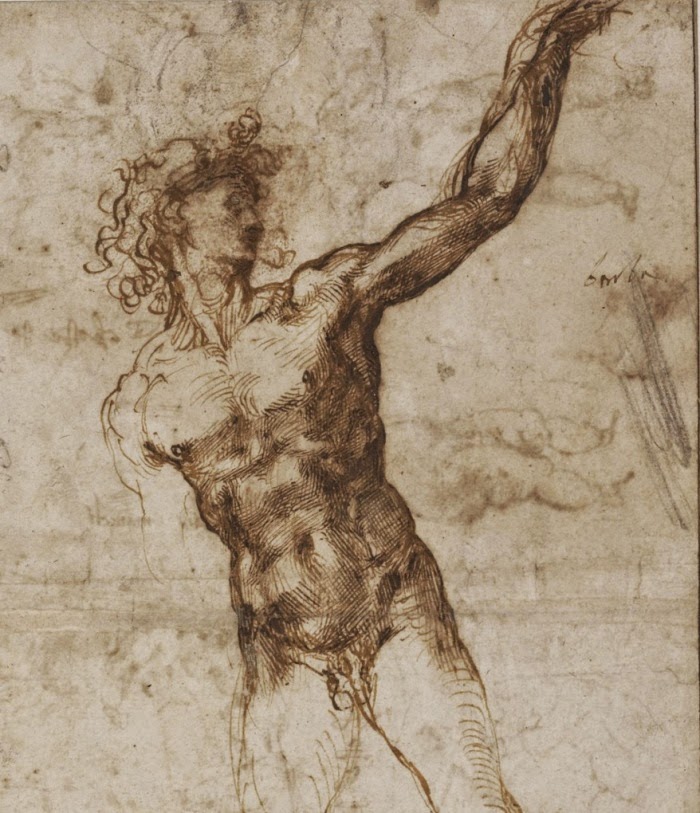
A comparison of this drawing with others made by Michelangelo during the period 1500 - 1510 such as the one below, confirmed Professor Joannides's suspicions concerning the Michelangelo connection.
Drawing of male nude by Michelangelo Buonarotti - c1500 - 1510
Next a scientific investigation of the bronzes was undertaken to see if a date could be confirmed for the bronzes in Cambridge. Samples of material from the bronzes was sent to a laboratory in Switzerland for a complex neutron scanning process and this yielded results suggesting the bronzes had been cast between 1500 and 1510 - this scientific evidence refuting the Sotheby's suggestion the bronzes were associated with Cellini and the middle of the 16th century. Interestingly, in this weeks Antiques Trade Gazette, dated February 21st, a update article indicates there is more scientific evidence to come which will be presented at a special research symposium to be held in Cambridge on July 6th. At this conference results from an investigation of inner core material from the bronzes might even be able to suggest a particular Renaissance workshop the bronzes were cast in - this further affirming the Michelangelo attribution.

Thirdly a clinical anatomist from Warwick University, Professor Abrahams, was consulted to examine the anatomical detail visible in the bronzes. It's well known that Michelangelo took a great interest in anatomy during his early studies in Florence and its documented that he undertook human dissections to deepen his understanding of the internal structure of the body. He would go on to make use of this knowledge in his sculpture and painting when producing representations of the human form that not only look convincing and realistic, but also show the effects of movement on the appearance of muscles beneath the skin. Professor Abrahams concluded that the anatomical form and detail of the two bronzes is incredibly accurate. When comparisons were made between the anatomy of the bronzes and other known and firmly documented and attributed work by the master - the conclusion was that the bronzes were surely by him. Comparison of anatomical details with the David marble sculpture completed in about 1504 make the arguments proposed even more compelling. Not only are the belly buttons on the male bronzes very similar indeed to that on the David, the arrangement of the pubic hair is almost identical as well - one expert commenting that this feature of the bronzes is almost like a signature!!

It's a pity that nothing is known of the history of the figures prior to 1878 - either in relation to who commissioned them from Michelangelo, why and what their original setting was - never mind what happened to them in the intervening centuries. What is exciting however is that the experts have estimated that they were probably made between 1506 and 1508 between the period when Michelangelo had completed the David sculpture in Florence and before he started work on the Sistine Chapel ceiling in Rome.

LOOKING AT THE BRONZES AT THE FITZWILLIAM MUSEUM ON FEBRUARY 28TH 2015
I looked at a variety of articles when preparing this posting including those in the Antiques Trade Gazette, The Times, The Telegraph and the Guardian. All were helpful, but by far the best source for anyone wishing to pursue this subject further is the book written by two of the experts, museum curator Victoria Avery and art historian from Cambridge, Professor Paul Joannides. All of the detail is there as well as more detailed coverage of how the final opinion was reached. It's available for £8.99 from the Fitzwilliam Museum shop and via the shop website.

THE BOOK ON THE ROTHSCHILDS BRONZES
PUBLISHED BY THE FITZWILLIAM MUSEUM IN 2015
I have loved doing the background reading for this story and having the opportunity to see the bronzes - first at the Royal Academy show in 2012 when they were labelled as "circle of Michelangelo" and today in Gallery 7 upstairs at the Fitzwilliam Museum in Cambridge. There they are in the centre of the Italian gallery with no glass case or ropes separating the viewer from the objects - "fantastico"! What I woud like to say finally is that the story is a wonderful example supporting the old fashioned concept of connoisseurship - the art of "knowing" about an art object and a concept which has been a bit old fashioned in recent years in undergraduate art history programmes . Here, in a modern context, a group of experts have been brought together, each with different fields of expertise and involving both art and science, to work on a pair of objects from 16th century Italy which has led them collectively to a stunning set of conclusions. Bravo!

The bronzes are on display at the Fitzwilliam Museum until August 9th. Check their website for details.

KBO - IAN


Sunday, 1 February 2015

CARAVAGGIO 'S "THE CARD SHARPS" - CHEATING AT CARDS IS NOTHING NEW


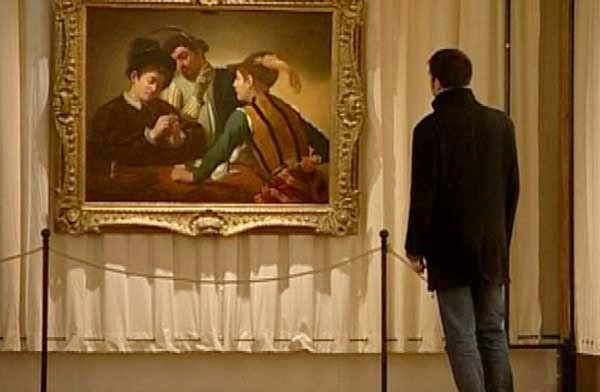
"THE CARD SHARPS" - by Caravaggio?
A PAINTING ALLEGED BY SOME TO BE BY ITALIAN BAROQUE ARTIST CARAVAGGIO

I've chosen another painting for a new series of postings focussing on a different Italian object each month, but this time its an oil on canvas. I've selected it for three reasons. Firstly it's been alleged by some art experts to have been painted by one of my favourite Italian artists - Caravaggio  and secondly, since 2013, it's been the subject of an important court case involving issues of attribution and of course that being the case, money. Thirdly, on Christmas Day 2014 we visited an exhibition at the Palazzo Barberini in Rome which focussed on Sir Dennis Mahon's collection and interests in Baroque painting which included works by Caravaggio - though the picture I have chosen to write about was not on view there. There's been an interesting judge's ruling about the case in January this year which I will come back to, but where to begin with this complex story? - well it's probably best to start by describing the picture  itself.

Below is an illustration of the oil on canvas picture which was sold by Sotheby's at their secondary salerooms at Olympia (now closed) in 2006. It measures approximately 4' 6" x 3'. The composition shows three men engaged in a game of cards round a table, all of the action taking place close to the picture plane. The young man expensively dressed in black with a plumed hat carefully scrutinises his hand of cards and sits opposite his opponent who is of similar age. The latter young man is a "cardsharp" or cheat engaged in duping his victim and we can see he has his right hand behind his back containing cards. Additional cards are also visible tucked into the belt of his doublet and he has a knife in a leather holder attached to his belt. An older man, slightly behind the young man in black, looks over the player's shoulder and is making a signal with his hand to his younger accomplice.


The painting is executed in a very detailed manner making it interesting for the viewer to observe minute aspects of such things as the men's clothing; even slits in the older man's gloves are visible. The three men themselves have a naturalism about them which suggests the artist has used models when painting the picture; this emphasises the realism of the event. The way the composition is lit adds a dramatic note to the action and the psychological nature of the interaction between the figures is further enhanced by the nervous glance the cardsharp is giving his master. The subject of cheating at cards is an old one, but here not only do we have one young man trying to dupe another, but also the impression the cheat himself is being corrupted by his master. The tense atmosphere evident in the picture ensures the viewer is prompted to think about the possible outcomes of the event!


When this picture was painted it represented a shift in taste towards a new style of painting which would eventually be described as "baroque" by art historians and Italian artist Caravaggio was one of its leading propoents in the late 16th century. He would go on to use many of the techniques illustrated in this painting in his major works with religous subject matter for important clients many of whom came from the catholic church, but that's not the issue here.
Michelangelo Merisi da Caravaggio
Self portrait
As mentioned earlier, the painting was consigned for sale at Sotheby's Olympia saleroom by Lancelot William Thwaytes. The work had been in his family since 1962, but at the time of its appraisal by experts at the saleroom it was considered a copy of an original by the artist and catalogued as such. It was described by Sotheby's in the following terms according to Bendor Grosvenor in Art History News back in 2013 - The Cardsharps - "a 17th century copy after Caravaggio's original now in the Kimbell Art Museum, Fort Worth, Texas" At the time the painting had been appraised by Sotheby's in-house experts and Caravaggio experts including Professor Richard Spear of the University of Maryland - all of whom thought it was an anonymous copy of an original work by the artist and probably carried out in the 17th century. When auctioned the painting was sold for a hammer price of £42,000 plus buyer's premium, producing a total of £50,400.

The picture was acquired by Denis Mahon, the well known art historian, though I'm not sure if he was the original purchaser at the Sotheby's sale. What matters is that Mahon argued the picture was a work by Caravaggio himself, suggesting that the artist may have painted more than one version of the subject. There is evidence to suggest he did this on more than one occasion, for example in the case of the painting known as "Boy with a Lizard". Sir Denis himself died in 2011 and the picture had been loaned to the London Museum of the Order of St John and insured for 10 million pounds!!
Art Historian Sir Denis Mahon
In January 2013 the person who had consigned the picture to Sotheby's in 2006, Lancelot William Thwaytes, lodged a claim with the courts against Sothebys seeking unspecified damages, interests and costs relating to the price difference between the £42,000 realised in 2006 and what its true market value was at that time had it been deemed to be a work by Caravaggio as determined by expert opinion. In other words the claimant was suing Sotheby's for negligence for not undertaking the appropriate research on the work prior to the sale and advising him accordingly.

Sotheby's went on to issue a statement saying that "its view that the painting is a copy and not an autograph work by Caravaggio is supported by the eminent Caravaggio scholar Professor Richard Spear as well as by several leading experts in the field". These included Helen Langdon, author of the 1998 biography on Caravaggio and Sebastian Schutze, a professor of art history from Vienna.

So where did it all go from here? Well, on January 16th 2015 High Court Judge Mrs Justice Rose ruled on the case which had hinged on whether Sotheby's had indeed carried out enough research and advised the client properly about the work. The court had received testimonials from a variety of experts including Professor Richard Spear and others. The auction house had also undertaken ordinary and ultra-violet inspection of the work which had revealed no 'non-copy features' indicating no conflict of opinion with the other evidence. It may thus come as no surprise that, taking all of the detail into account, Mrs Justice Rose dismissed the claim outright. Her judgement stated that although both parties had admitted there was "no single ultimate authoritative voice on the attribution of Caravaggio as there is with some artists", she was firmly of the view that Sotheby's were entitled to come up with the opinion that the quality of the painting was not sufficiently high to merit further investigation".

It doesn't end there though. Having won the case Sotheby's are now claiming 3.75 million pounds full costs from Mr Thwaytes and on January 16th the judge ordered an intermim payment of 1.8 million pounds should be made to Sotheby's. Given that Mr Thwaytes had also employed a high profile firm to represent him, his own bill must also be huge, though according to the Antiques Trade Gazette it has emerged that the claimant may have insurance cover and 3rd party litigation funding. And will he appeal against the judgement? Well it would appear that hasn't been decided yet.

Articles consulted for this blog item include:

The Antiques Trade Gazette, p2, Issue 2176, 31st January 2015

Bendor Grosvenor, "Sotheby's sued over Caravaggio attribution" Art History News, February 15th 2013.

THIS BLOG ITEM IS NUMBER 26 OF A SERIES OF POSTINGS WHICH BEGAN IN JANUARY 2015.
Subjects range from the purchase of a holiday home in the little town of Citta dell Pieve, Umbria to geographical, architectural and art history topics connected to Umbria, Tuscany and Italy in general. Please register if you would like to be alerted to future postings, Thanks - Ian.