Thursday, 25 August 2016

THE DEVASTATING EARTHQUAKE IN UMBRIA - AUGUST 24TH 2016.

It's been two months since my last post and I never anticipated I would be writing an article concerning an earthquake close to where we have our place in Italy. I'm at home in Lincolnshire at the moment, so when I came down for breakfast and switched on the TV I was shocked to see the devastation caused by the overnight earthquake in our own area of Umbria in central Italy. My first concern was for our friends Francis and Michael and Janice and Marcia - we were glad to get an online message from Francis that morning saying they had been woken by the quake at a quarter to four, that they felt the house sway a bit, and that they then went back to sleep. In the morning they were also shocked to see the effects of the quake with an epicentre south east of Perugia - only a matter of about 100 miles distant from where we are. TV reporters were saying the effects of the quake had been felt from Naples in the south as far north as Milan and beyond. We are also  relieved the impact in the area round Lake Trasimeno has been minimal. Francis and Michael later in the day kindly went round to check out our property and reported that all was fine with that too.

The epicentre of the Umbrian Quake was near the town of Amatrice
and measured 6.2 on the Richter scale. 
Having said all of that we are devastated by the impact of the earthquake in the mountainous areas around the towns of Amatrice and Norcia where whole villages have been razed to the ground and as I write this posting almost 250 are dead with more unaccounted for. Rescue workers, toiling in unsafe conditions, unstintingly continue to look for survivors - even though aftershocks make their task dangerous to say the least. I was impressed with the words of the Italian prime minister broadcasting to the nation and the world promising the very bext help possible to these damaged communities. I found myself praying for the victims and their families.

Earthquake in Umbria - 24th August 2016
Italy, as many of you will know, is particularly prone to earthquakes and there have been many up and down the whole country during recorded time as the map below shows. The Appenine mountains, which form a spine down the length of the peninsula, are relatively young in terms of geological time, just like the Alps. As such they are subject to the stresses and strains of movement as the plates beneath them move and the process of  mountain building continues. 

Earthquakes in Italy 461 BC - 1997 courtesy of Maps.com
The most susceptible zones are those coloured dark orange.
Umbria in the region of the Appenines clearly falls within one of those zones. 
The movement of one plate against another, over a long period of time, causes the production of fault lines and as pressures accumulate so something has to give - the result - an earthquake. This one measured 6.2 on the Richter scale and the epicentre, at a shallow level beneath the surface, produced the shock waves which have caused the devastation. Whereas vulcanologists often fare well at predicting eruptions of such Italian volcanoes as Stromboli and Etna on Sicily - seismologists the world over find it very difficult to predict quakes. A particular problem appears to relate to the area of the Tyrrhenian Sea to the west of the Italian peninsula where a trench beneath the sea is spreading thus exerting pressure on the Appennine range. More recent "trench migration" to the east of Italy, in the Adriatic Sea area, further complicates the problem and this Umbrian quake is related to it.


Who knows where and when the next quake in Italy will strike? Investigators will no doubt be eventually concentrating some of their efforts on looking at why a few buildings, old and new, survived the devastation in the affected areas. The Italian authorities and the seismic centre based at Perugia University will be working hard to encourage more buildings to be built with adequate earthquake protection. In the meantime lets hope that trapped people in Umbria who are still alive beneath the wreckage are rescued soon and that the survivors continue to be well looked after and cared for!!

Tonight's ITV news has just revealed a 14 year old English boy lost his life in the disaster - his parents are being treated in hospital. A very moving piece of film showed a little girl called Julia being taken alive from the wreckage after 15 hours beneath the rubble. Earthquakes continually inform us that the huge powers of nature have no regard for human life, but stories like these are are also a reminder of the nature of our own humanity!!

THERE ARE GETTING ON FOR A HUNDRED POSTS HERE WRITTEN OVER SEVERAL YEARS - I'D BE DELIGHTED IF YOU HAVE READ THIS ONE AND DECIDE TO BE A REGULAR FOLLOWER - IAN


Sunday, 26 June 2016

GUIDO BRUNETTI - THE VENETIAN SLEUTH AND ITALIAN "FOODIE"

Well - as I finish off writing this latest posting (apologies for the delay) I'm still shocked that the United Kingdom has just voted to take us out of the European Union and I can't help feeling a sense of loss. Substantial change is inevitable but let's hope it's not all negative for I don't intend to let it all stop any of our enjoyment of travelling to Europe and to our beloved Italy. Perhaps we should think of having our UK base in Scotland? - it's a serious thought!

For what seems like ages I've enjoyed getting to know Commissario Guido Brunetti, the Venetian detective whose exploits have been written about in the deliciously readable novels of American crime author Donna Leon.

DONNA LEON - AMERICAN AUTHOR OF THE GUIDO BRUNETTI CRIME NOVELS
ALL OF THEM SET IN VENICE
Though a completely fictional character, Brunetti is the sort of bloke I think I would have enjoyed meeting in person. Not only has he always shown himself to be "individual" and principled in his approach to crime and its detection in the enigmatic city of Venice, he's proved interesting in other ways too; in his dealings with ridiculous bureacracy and a corrupt Italian state; in his connections with some of his dubious colleagues; in his complex relationship with his University lecturer wife Paola; in facing up to his snooty aristocratic in-laws and as a father of two children who grow up during the course of the twenty or so "whodunnit" tales penned by Leon. And I haven't even mentioned his varied hobbies which include reading classical literature. In all of these things he's been a delight and I dread to think of him finally retiring when there will still be crimes to be solved, but no more stories to be told. None of of the aforementioned is focussed on here however, for this posting is about Guido Brunetti's love of food!

THE FIRST OF THE DONNA LEON GUIDO BRUNETTI NOVELS
WHERE MUCH OF THE STORY UNFOLDS IN THE RENOWNED VENETIAN OPERA HOUSE

A NUMBER OF ACTORS HAVE PLAYED THE ROLES OF GUIDO & PAOLA BRUNETTI
 IN FILM VERSIONS OF THE NOVELS
IN THE BOOKS MANY OF THEIR INTIMATE CONVERSATIONS TAKE PLACE
 ON THEIR APARTMENT TERRACE OVERLOOKING THE GRAND CANAL

Although I probably knew it already, when we started to visit Italy seriously a few years ago and then bought a place there more recently, I soon discovered that it's a nation obsessed with food - the buying of it, its preparation and cooking and of course the eating of it. When Italians come together to talk and chat - in the the street, in a bar, at meal times at home, or almost anywhere for that matter, they talk about food and work matters rarely get a look in. It's not surprising therefore that in Italian detective novels - the world of food figures strongly. Another of my favourite Italian crime detectives, Inspector Montalbano, who's the central figure in the novels of Andrea Camilleri, spends alot of time cooking meals using fresh ingredients in his sea front house in the fictitious Sicilian town of Vigata, and many an hour leisurely eating in local bars and restaurants. Commissario Guido Brunetti on the other hand seems to have less time available for cooking and taking meals, but still he never misses the opportunity to snatch a tasty tramezzino (sandwich) accompanied by an espresso when walking from one part of Venice to another. Lunch times eating at home are also often a stolen luxury in many of the stories. According to Leon "to Italians eating well is not an achievement or a cause for self promotion and pride - it's simply something you do twice a day in a manner that will provide as much physical pleasure as possible". Brunetti certainly seems to live up to that mantra in the novels. Be it a great lasagna made by his mum (Through the Glass Darkly) or a recipe for ravioli con funghi that Paola teaches her daughter to make (A Noble Radiance) - the food prepared and served in the novels engenders in the reader a wish to savour it and that possibility, I recently discovered, has become more of a reality than one might have thought!.

A few months ago, whilst staying with an elderly lady friend in Philadelphia, I came across a book on a coffee table entitled ""BRUNETTI'S COOKBOOK" - a collaboration between Donna Leon and cook Roberto Pianoro (Atlantic Monthly Press 2009). I had no idea it had even been written so I spent several hours one rainy afternoon that weekend exploring its contents. A few weeks later, after returning home to Lincolnshire, a parcel arrived and there inside it was a copy of the same book my friend had ordered for me. Heaven!

The book includes an introduction by Donna Leon, Roberto Pianaro's recipes and extracts from the appropriate novels. There's some interesting commentary about the changing nature of Venice and how the decreasing native population, coupled with the incessant drive to serve the tourist industry, is all having a dreadful impact on local shopping in the city and the availability of fresh produce and food shops in certain areas. The author bemoans the fact that one street she used to visit every day to buy food is now flooded with tourist tat shops selling garish Chinese made carnival masks, fridge magnets and cheap Murano glass. Leon does however comment on the enduring Rialto food market calling it one of the glories of the city. Seasonal products of the best quality along with fresh sea food, meat and everything you can think of is all for sale in this amazing mileu right in the heart of Venice. Anyone who hasn't experienced it should put in on their visit list next time they visit the city.


THE RIALTO FOOD MARKET - VENICE
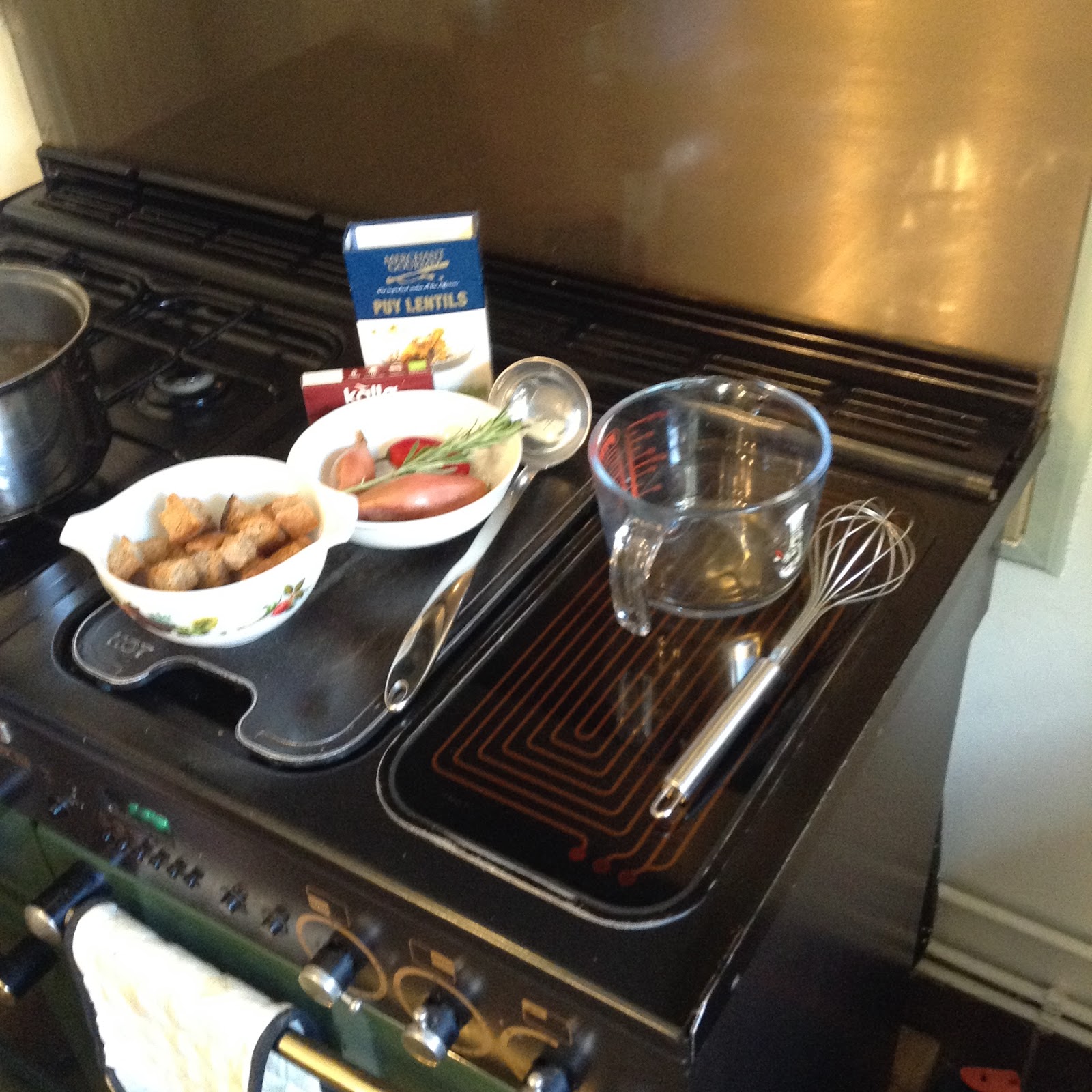
I couldn't finish this posting without reproducing one of the recipes from Brunetti's cookbook and having a go at both preparing it and eating it for this short posting. Well having a go is a bit of an exaggeration on my part as my partner Jon does all the cooking in our house. But what have we chosen I can hear you asking? Jon and I are both soup fans so we've chosen ZUPPA DI LENTICCE CON PANCETTA (lentil soup with bacon) which is described in the novel "Uniform Justice". My mouth is watering as I type this sentence and the thought passes through my mind - how could one possibly not enjoy a dish with a title like that? As Jon cooks the dish I can hear him bemoaning the fact that the recipe is unspecific in its method - but that's the nature of Italian recipes - they allow for a little bit of imagination and flexibility - there are no Delia Smith prescriptions here!

Here is the extract from the novel quoted in the cookbook.

"Brunetti arrived before the children did, so he opted to keep Paola company while she finished preparing the meal. As she set the table, he lifted the pots lids and opened the oven, comforted to find nothing but familiar dishes: lentil soup, chicken smothered in red cabbage and what looked like the radiccio di Treviso.
      'Are you bringing all your detective skills to bear in examining that chicken?' Paola asked as she set glasses on the table.
      'No, not really,' he said, closing the oven and and standing upright. 'My investigation has to do with the radicchio, Signora, and whether there are perhaps traces in it of the same pancetta I detected in the lentil soup.'
      'A nose as good as that,' she said, coming over and placing the tip of her finger on it, 'could effectively put an end to crime in this city.' She lifted the lid from the soup and stirred it round a bit, then said, 'You are back early.'

And the recipe from page 108 of Brunetti's Cook Book.

Serves 4

2 cups of dry green lentils
2 tablespoons of extra virgin olive oil
1 shallot finely chopped
3 slices of bacon, finely chopped
a pinch of finely chopped fresh rosemary
2 bay leaves
1 fresh chilli
2 pinches of salt
2 crushed beef bouillon cubes
croutons, to serve

Tip - go easy on the chilli if you are not a fan of "hot" food.

Wash the lentils. Heat the oil in the pan or casserole and fry the shallot and bacon gently with the fragrant herbs, the chilli and the salt. Add 6 cups of hot water, the crushed stock cubes and finally the drained lentils. Cover and cook over moderate heat for 45 mintues. Once cooked, place half the contents in a bowl and blend the remaining half by hand with a whisk or egg beater. Return the other half, set aside in the bowl, to the blended mixture and continue cooking, uncovered, for 20 minutes. Adjust the seasoning with salt and serve the soup with croutons.


JON PREPARES THE LENTIL & BACON SOUP
We've had a lot of fun trying out and eating recipes from the book and I can thoroughly recommend getting hold of a copy if you want to have a go too.


CIAO & KBO - UNTIL NEXT TIME - IAN

Please take a look at some of the many postings that form this blog. Subjects range from Italian locations and special places we have visited and topics and drawn from Italian history, architecture, art history decorative arts. Whilst there is an emphasis on Umbria and Tuscany other areas are covered too. Thanks!


Saturday, 16 April 2016

DINING AND SHOPPING "EATALIAN" STYLE - THE "EATALY" EXPERIENCE - IN AMERICA!

It's a change of tack this month as I've recently travelled to the United States to do a series of lectures there. My travels took me to the prairie city of Chicago which I last visited in 1990, so it was wonderful to make a long awaited return visit and this time I stayed in a 17th floor room in a downtown hotel, visted the late 19th century Driehaus Mansion Museum (where, incidentally, there was an exhibition of Downton Abbey costumes drawing huge crowds) and spent a day out in the suburb of Oak Park to see Frank Lloyd Wright's house and studio and other properties designed by the illustrious American architect. On the first day in town my colleague and friend Jenny McCahey, asked me if I'd ever been to "Eataly" and I said I was a frequent visitor to the country, having been there only in February this year. "I don't mean the country" she said "its the shop and restaurant I'm talking about - its famous" I had to admit to Jennie that I'd never heard of it! We were having this conversation on the pavement outside the hotel and the doorman suddenly came forward and exclaimed - "Any visitor to this town has to go to "Eataly" - it's just round the corner and you'll be amazed!".

Eataly was literally a couple of blocks from the hotel and when we came to the front entrance I was filled with anticipation as to what we'd find inside. The best way to sum it up  - think of a huge city department store devoted to one thing - Italian food - and you have it in a nutshell. It is quite simply a phenomenon.


THE CHICAGO BRANCH OF "EATALY"
The whole emporium is dedicated to celebrating the Italian food experience - both in terms of selling fine artisan, organic foods and wines from the home country supplemented with fresh, seasonal organic locally sourced produce - and also providing customers with freshly cooked "Italian" meals and snacks. In different parts of the two storey humungous store there was for example a pizza-pasta restaurant, a prosecco bar, a gelato counter and a coffee bar - and so it goes on. It's all a bit overwhelming when you first enter but the cleverly designed orientaion space at the entrance helps sort it all out. There's even a bookstore, a cooking school and a private events venue.


Eager to discover more about this intriguing shop cum restaurant I was soon talking to some of the friendly staff  and reading the information panels about the history of Eataly.


Eataly was and is the brainchild of Oscar Farinetti an Italian entreprenuer. He has an interesting background. In 1978 he began working for UniEuro, a small Italian appliance and food retail store and played a key role in developing it in to one of the largest retailers of electronics in the country - opening 150 stores between 1978 and 2003. Moving on in 2003 he founded Eataly in 2007 in the Lingott district of Turin. The shop was to be located in a closed down vermouth factory and easily accessible by metro from the centre of town. From the beginning he thought big and his mission was simple "to make high quality Italian foods available to everyone, at fair prices and in an environment where people can shop, learn, eat and enjoy themselves." The concept of combining excellent quality produce and food in an Italian style market environment would prove to be a brilliant business model. 


THE VERY FIRST "EATALY" STORE IN TURIN - ITALY
The New York branch of Eataly, located near Madison Square Park, opened in 2010 as a joint venture between Eataly, Italy and the Batali and Bastianich Hospitality Group. At over 50,000 square feet  and creating 300 new jobs it was a welcome addition to the Big Apple food scene and opened in August of that year with huge press coverage. Batali described it at the time as "a grocery store with tasting rooms". Two weeks after opening there were still long queues down 5th Avenue as would be customers patiently waited to experience Eataly. Today, according to my New York pals, its packed out most of the time and difficult to get a seat during peak periods.

EATALY - NEW YORK
On December 2nd 2013 Eataly opened its Chicago branch, the one I was experiencing, at 43 Ohio Street and with 63.000 square feet it was even bigger than the bustling New York store. The Chicago branch is co-owned by Mario Batali andJoe Bastianich and its estimated the store cost in excess of 20 million dollars to open. 

I went to Eataly, Chicago twice during my stay - once at lunch time and once in the evening. On both occasions it was a terrific experience and not one to be rushed. Wandering through the various departments we leisurely examined hundreds of Italian wines, tarried over a department displaying endless varieties of pasta and watched the butchers preparing the meat for amazing displays. Cheese tasting was another wonderful diversion. In the pizza/ pasta restaurant our waiting staff were friendly, knowledgeable and suitably advisory in helping us choose a home made pasta dish. In the evening I chose a tagliatelle with bolognese sauce topped with shavings of parmesan which was simply delicious and it was perfectly accompanied by a generous glass of prosecco. Afterwards we tried our hand at the downstairs coffee shop and that didn't disappoint either. 


DINING WITH MY FRIENDS JENNIE AND SCOTT AT EATALY - CHICAGO
Since opening the store in Turin the company has not looked back. The chain opened more stores in Italy including one in Rome, its largest megastore, in a disused Airport Terminal building near Ostiense station. There's now a store in Tokyo and plans to open other outlets in Boston, Hong Kong, Montreal, Mexico City, Moscow, Paris, Rio de Janeiro, Philadelphia and Washington DC. How could I not know about this Italian food chain?? - well it hasn't arrived in Britain yet, but I'm delighted to know there's one planned for London in the near future. If you are an Italian foodie - go find one and enjoy!!!
EATALY - JAPANESE STYLE - THE TOKYO BRANCH
CIAO AND KBO - IAN 

Thursday, 24 March 2016

A PAINTING BY PIERO DELLA FRANCESCA - AN ANNUNCIATION NOT TO BE MISSED

Well Easter is almost upon us again and March 25th, as well as being Good Friday, also happens to be the Feast of the Annunciation - the day the Angel Gabriel visited Mary and gave her the news she would bear a son through the intervention of the holy spirit. During my visits to art galleries in Britain and abroad over the years I've come across many Annunciation paintings, many of them commissioned to originally adorn the walls of monasteries and churches in the late medieval and Renaissance periods. Carlo Crivelli's huge and impressive painting in London's National Gallery comes to mind and when I visit I always search it out. It's attention to detail and mastery of mathematical perspective is always a marvel to me and I love the way it deals with a second subject connected to the life of St Emidius. It's rich in symbolism too.

Carlo Crivelli - The Annunciation - National Gallery London 
Fra Angelico's tranquil and simple Annunciation scene in a painting displayed in the quiet monastery corridors of San Marco, Florence, is another favourite and I can recall its detail now sitting at my desk.

Fra Angelico - Annunication - Monastery of San Marco, Florence
The one I want to tell you about today though is special to me and part of its subject just happens to be one of my favourite fridge magnets; its shown below. I saw the painting and bought the magnet almost three years ago just after we'd bought our apartment in Umbria and made our first visit to the historic city of Perugia just 50km away from Citta della Pieve. Until that time I'd always associated the city with the terrible, violent murder of English student Meredith Kircher and the trial of her house mates Amanda Fox and Rafaello Sollecito - not exactly a subject I like to recall often and its a legacy Perugia doesn't deserve. But then we went to the city and it was a revelation, Not only does it have a spectacular hill top "centro historico" with splendid views over the surrounding countryside, it also has a wonderful cathedral and special civic buildings too. During that first trip we visited the National Gallery of Umbria in the Palazzo dei Priori just off the main piazza and it was a sublime experience. The art collection is a fine one and includes works of the Umbrian School of painting as well as pictures related to commissions undertaken for city churches and other buildings during the Renaissance. It's a must see stop off if you visit the city.

My Annunication Fridge Magent from the National
Gallery of Umbrian Art - Perugia
This is the fridge magnet I mentioned above and it shows a detail from the larger painting in the Perugia Art Gallery. A kneeling Angel Gabriel in one of the most wonderful pale blue robes kneels before the Virgin Mary who we can't see. Behind him is a beautiful receding columned arcade.

The Annunciation scene is part of a polyptych painted by the renowned Renaissance artist Piero della Francesca. It was commissioned and produced as an altarpiece for the convent in Perugia known as Sant Antonio delle Monache - the Convent of St Anthony - and it remained there until 1810. Following Napoleon's invasion of Italy and his purging of religous institutions it was transferred to a picture gallery in the city.

The overall composition of the polyptych, as its seen now, was described by Vasari in the 16th century. In the centre the Madonna and Child is flanked by St Anthony of Padua and St John the Evangelist on the left and by St Elisabeth and St Francis on the right. Underneath there are, unusually, two predellas (strips of paintings), the upper one featuring St Clare and St Agatha and in the bottom one three miracle scenes including St Anthony bringing a boy back to life and another showing St Elisabeth saving a boy from a well. A further one shows the stigmata of St Francis.

THE ST ANTHONY POLYPTYCH - PERUGIA ART GALLERY
BEFORE 1468
The Annunciation scene is at the top of the polyptych and has a stepped outline. It looks different to the rest of the art work and its shape and the fact that its stylistically at variance with the rest would suggest it was added later - its shape determined by the space available in the place wihere the altarpiece was displayed in the convent. Restoration work carried out on the painting in the 1990's supported the theory that it's a later addition to the main work.

THE ANNUNCIATION SECTION OF THE ST ANTHONY POLYPTYCH
by PIERO DELLA FRANCESCA

The Angel Gabriel and the Virgin are placed in the foreground of the painting close to the picture plane. Between them is the illusory colonnade which gives the painting great depth - the depth also suggested by the red and white pavement. Its a beautifully painted picture and it creates in the viewer a feeling of serenity and peace.

Piero della Francesca (1415-1492) is one of my favourite Renaissance painters and I first came across his work at the National Gallery in London where his - Baptism of Christ in the Sainsbury Wing always draws large crowds.

Self-Portrait of Piero della Francesco as it appears
in his painting "The Resurrection"

He was born in a village called Sansepolcro in the Tiber valley, the son of a tanner, somewhere around 1415, but relatively little is known about his life. He seems to have led a quiet, provincial existence, though he probably studied under Veneziano in Perugia, in the late 1430's. He's not recorded though as belonging to any particular workshop. Most of his painting career appears to have been spent in his home town of Sansepolcro and in the Tuscan town of Arezzo- but he also did some freelance work in Rome, Ferrara and Urbino. Perugia was on the main route from Sanseplcro to Rome and an important centre of culture in the 15th century. As an accomplished artist it would have been appropriate for him to pick up a commission here. The St Anthony polyptych is a mature work in terms of his career.

As well as becoming an artist, however, Piero was a master geometrician producing a learned treatise on the rules of perspective. It's this combination of skills and insights which create his unique, alluring style. His paintings are underpinned by precisely worked out geometrical compositions which focus on horizontal and vertical lines, circles and triangles all arranged in a balanced and harmonious whole. The use of a clearly defined vanishing point in the centre of this composition (its right in the centre of blank arch at the end of the arcade) with all the orthogonal lines leading to it creates an impression of great depth behind the angel and the virgin. Careful use of light and dark colouring (the blue of the angel's robe I find just gorgeous) help create the peacful, tranquil atmosphere which exudes from the picture. Only the white dove surrounded by a golden shower representing the holy spirit is suggestive of movment in this momentous scene as it flutters towards the body of the virgin Mary.

I look at my little fridge magnet every day - but it's been a pleasure to have had the opportunity to consider the entire work again at this significant time of year in the Christian calendar. I hope you will enjoy it too. 

PLEASE CONSIDER SIGNING UP TO BECOME A REGULAR READER - THERE ARE GETTING ON FOR A HUNDRED POSTS HERE WRITTEN OVER SEVERAL YEARS - CHEERS. IAN


Wednesday, 9 March 2016

SAYING HELLO TO DAVID - MICHELANGELO'S MOST FAMOUS SCULPTURE

I'm sitting here in my Lincolnshire study thinking about a talk I'm preparing for a trip to the States at the end of the month, but I've suddently become distracted by a tiny 3 inches by 3 inches fridge magnet calendar I bought in Florence last year. I have it fastened to the side of the filing cabinet which adjoins my desk. The image for the month of March is of the famous Michelangelo statue of David and its an iconic and alluring work I've been meaning to blog about for ages.


Only a few weeks ago, when Jon and I were in Florence, we'd renewed out acquaintance with it and said "hello" to David as we saw him on his pedestal outside the main entrance to the Palazzo Vecchio.
THE "DAVID" STATUE OUTSIDE THE PALAZZO DELLA SIGNORIA, FLORENCE
I first came across David in another context years ago at the Victoria and Albert Museum in London long before I'd become seriously interested in the history of art. Strolling along one of the ground floor corridors, not really knowing much about what I was looking at, I came across an entrance to a huge galleried room and from my viewpoint all I could see was what looked like a massive 14 foot tall marble statue of a handsome and nude young man. Curious to discover more (who could resist such a challenge?) I ventured in to explore this amazing and colossal work of art.

VICTORIAN PLASTER CAST OF MICHELANGELO'S "DAVID"
IN THE CAST COURTS AT THE VICTORIA & ALBERT MUSEUM IN LONDON
There's something about sculpture which draws me to it like no other art form and I think it must be its three dimensionality - enabling as it does viewings from multiple angles. Today, be it a Henry Moore a Tingueley or a Michelangelo - I'm always enthralled and as I think back to that day at the V and A - I realize the viewing of David was a singular step in my growing attraction for Renaissance art.Years later I would find myself taking student groups to see it and we would sit on fold-up stools surrounding the sculpture and have the most engaging and wonderful discussions about what was in front of us and how it was to be interpreted and what people were experiencing as they looked at it. I can remember some of these sessions as if they took place yesterday and I've just thought of the fact that during one of them a young Prince William joined our viewing briefly whilst on a tour of the gallery with his art tutor from Eton College. I can hear you saying, however, "but David's in Florence" and indeed he is. The sculpture at the V and A is one of hundreds of accurately copied plaster casts of world famous works of art that were commissioned and collected by the museum in the second half of the 19th century and displayed in these Cast Courts to help students study and educate themselves about sculpture.  When you think about it this was a progressive and forward looking initiative for those unable to visit the sites where the originals were. Today these cast courts are gems of the museum and worthy of a visit at any time of year. The room where the David can be found has been recently restored to its original decorative scheme and the David statue has also been cleaned as can be seen in the illustration below.

CLEANING THE "DAVID" PLASTER CAST AT THE V & A
In the Spring of 1501 the 26 year old Michelangelo Buonarotti was working away from his native Florence in Rome when he received a message from friends to return to his home city to try for an important sculpture commission. A huge block of fine Carrara marble, which had been standing in the yard of the Office of Works of the cathedral for 40 years, was to be offered to an artist for an important sculpture commission to produce a statue that would stand high up on one of the Duomo's buttresses. The piece of marble was one Michelangelo had had his eye on for a while and it presented many challenges. The block had been quarried at Carrara near Pisa in about 1460 and taken to Florence and abandoned. One of the biggest challenges for an artist in 1501 was to sculpt a block which had first been used by another sculptor. The artist Antonio Rossellino, assistant to Donatello, had attempted the first blocking out stages of a figure of Hercules in the 1460's, made mistakes and then lacked the skills to put them right. The young Michelangelo was attracted to solving this problem as well as being drawn by the opportunity to produce a giant statue that would be seen by everyone in Florence, locals and visitors alike. In his home city the chance of improving his own and his family's good name was irresistable.

Michelangelo took the comission and agreed to complete the statue in two years and for the sum of 6 gold florins a month. The subject was to be a traditional Old Testamont one - the story of David, slayer of the Philestine giant Goliath. Within a month he'd completed the modellos for the piece and was ready to start work on the block. A secretive artist he ordered the block to be completely covered with a wooden screen and he would soon be working hard with hammer and chisel commenting "my task is to remove everything that is not David" - an insightful way of expressing how the sculpture was to be created. This technique of removing material from wood or stone by a carving process to reveal the sculpture is an awesome task. Once material has been removed it can't be replaced. To produce something like the David is mind boggling in its complexity of creativity and execution - particularly when the block was flawed to begin with. In reality - it would take almost twice as long to produce, despite the artist toiling ceaselessly day after day on the project. He was soon to discover that the great marble block was flawed in another way - in what was to be the area of David's legs, the marble was streaked with veins making the potential for breakage huge. What a daunting task!


The statue was virtually finished by the sumer of 1504 and what emerged from behind the screens was a 14 foot tall nude male Greek god like figure of David, the maximum height he could get out of the block. It had no drapery, an exaggerated head and huge hands. The artist was compensating for the fact people would view it high up on the parapet of the Duomo. First persion to see it was the Florentine Gonfalonier - Pier Soderini - who according to Vasari writing about the incident in 1568 - is noted as saying to the artist that David's nose was too thick. At least he wasn't commenting on another part of the statue's anatomy! Michelangelo is said to have climbed the scaffolding surrounding the statue, grabbing his chisel on the way and also collecting a handful of dust from one of the scaffold planks. When he reached the head level he struck the chisel on a piece of marble and allowed dust to fall through the scaffolding to the floor - in fact he hadn't touched the statue at all.
When he climbed down to the ground Soderini is noted to have said to Michelangelo."You have given it life!"

So impressed were the commissioners with the statue that the decision was soon taken not to place it high on the duomo and a committee was formed to consider other suitable sites. After much debate and disagreement, the decision was taken to place it on a pedestal outside the Palazzo Vecchio - the civic headquarters of Florence in the Piazza della Signoria. The statue was to be moved to its new place starting on the 14th May 1504 but even before the delicate operation began an incident occurred which shocked Michelangelo and the commissioners. Youths threw stones at the statue in the evening when it was  dark. Were they objecting to the statue's nudity or to its potential political symbolism? Nobody seems to have known. It took 4 days and 40 men to move the statue to the civic square. Finally, after great difficulty, it was hoisted on to its new pedestal on the 8th June and officially unveiled to the public on the 8th September 1504.

Such a huge and monumental classical statue had not been seen in Europe since antiquity. Many considered Michelangelo had achieved the impossible, producing such a magnficent and grandiose unique sculpture which would become the very symbol of the city itself. When I've taken students to see the David reproduction statue in London I've always tried to draw out of them what they see as being most important about what Michelangelo achieved when he created this beautiful object.

The artist, always more of a sculptor than a painter, had made the statue in the image of a beautiful Greek God and interpreted David as an "ideal" man embodying all the attributes of the finest specimens of the type. Yet at the same time David is represented as an individual and a man of the moment. Other earlier statues of David, the one undertaken by Donatello for example, show him victorious over his opponent, his foot on Goliath's head. Here the deed has not yet been committed and David is only moments away from firing his shot off against his opponent. Michelangelo's intimate knowledge of anatomy, gained by meticulous study and dissection of human bodies, show not only his ability to represent the male body accurately, but also to show the behaviour of muscles in tension as David gets ready to use his sling. Notice the tension in the huge hand hanging next to his leg. Similarly, if one looks at the head of David - the psychological angst is also evident; his expression is full of apprehension.

The subject of "David" was highly significant in relation to commission. In the Old Testament David had fought for the freedom of his people - an underling against a great giant of an opponent, but he came out victor. The message is clear - Florence is not to underestimated or messed with by its potential enemies or the consequences could be dire. David was the symbol of Florence's freedom and strength.
DAVID IN FLORENCE'S ACCADEMIA GALLERY
Michelangelo returned to Rome to work in 1505 and David remained on his pedestal outside the Palazzo Vecchio all the way through to 30th July 1873. Following the Unification of Italy the decision was taken, for conservation reasons, to remove the original to Galleria dell Accademia and he arrived there on August 8th of that year. He was placed in a dedicated space in the Tribune Gallery and has remained there ever since, undergoing a major cleaning and restoration in 2004. A reproduction of the original was produced and placed on the original pedestal outside the Palazzo Vecchio and a rather pathetic bronze facsimile was also erected in the Piazza Michelangelo high above the city. David remains one of the most popular tourist attractions in Florence and every year thousands flock to see him in the Galleria. Some days the queues wind all the way round the block.


Oh - and two final things. When a visit to the Cast Courts at the South Kensington Museum was proposed for Queen Victoria the powers that be decreed that she might be offended by David's nudity. A specially designed plaster fig leaf was produced to cover the statue's modesty and there is still a hook for this at the rear of the statue above his bottom. It is shown below. The other point is amusing. So iconic has the David become in modern society that it has been used for all sorts of paraphernalia. I've seen table lamps sculpted from plastic of the David's head with different coloured light bulbs inside, fridge magnets of David with assortments of 'cool' clothes to dress him in and adverts like the one below for designer underpants. Is this a travesty? - I don't know the answer to that question - you can make your own minde up about that one!!


Ciao & KBO
Ian