Tuesday, 27 June 2017

SUMMER FIESTAS IN UMBRIA - THE TOWNS OF SPELLO & BEVAGNA

It's mid June here in Umbria and the weather is sunny and bright every day, but its also hot and very dry as well. Whoever invented the siesta had the right idea. Get up early in the morning, do your jobs, have a nice lunch and then have a well earned rest during the heat of the early afternoon. By 4 o'clock its started to cool down again and feeling refreshed, you rise and get ready to enjoy the rest of the day. Perfect. This was the lusciously lazy pattern of our days in Umbria in recent weeks - how ever would we readjust when we returned to the UK?

June is also the time of year when, in this part of Italy, the annual Umbrian and Tuscan festivals get underway and for a period of about eight weeks most towns and villages have some sort of event which not only brings the community together, but also provides entertainment and spectacle for visitors too.  I'm always amazed at the huge quantities of energy and creativity that's poured in to these festivals by the locals - but civic pride, something we seem to have lost in the UK, plays an important part. Many of the festivals celebrate cultural traditions that go back centuries. Sometimes they have roots in a religious festival such as a Saint day for example, but on other occasions they are more associated with centuries old confraternities and brotherhoods connected to particular districts in a town. These festivals provided the perfect outlet for long established group rivalries but always evolved so they were conducted in a spirit of friendly competition. This reasoning is probably why they evolved in this way in the first place - they prevented a township's men from knocking the hell out of each other, but allowed for one group to be prominent, if only for 12 months. The following year it would and still does happen all over again.

This June we decided to visit two contrasting Umbrian festivals on the same Sunday - one at Spello and the other at Bevangna - two ancient towns not far apart and only 50 kilometers from our place near Lake Trasimeno.

The little Umbrian town of Spello (who could not be drawn to a town called Spello?) was our first stop and every year it holds a special annual festival combined with the Corpus Domini feast. This is an event which celebrates "the most holy body and blood of christ" - in other words a thanksgiving for Christ's teaching in relation to the ritual of holy communion.

THE HILLSIDE TOWN OF SPELLO - UMBRIA
ONE OF SEVERAL ENTRANCE GATES IN TO THE LITTLE TOWN OF SPELLO
The stone built town is a pretty and ancient walled place, beautifully conserved and with a population of only about 8000. It's sited 15 miles east of Perugia not far from Assisi and sits on a steep hillside below Mount Subasio. It's myriad of stone buildings seem to literally spill down the hillside. The roots of Spello can be traced back to the pre-Roman period, but it was the latter who developed its importance by making it a Roman colony. It was then known as Flavia Constans under the reign of Constantine the Great. Today the "centro historico" within the old medieval walls built on Roman foundations has an atmosphere steeped in history and we were looking forward to exploring its historic buildings, nooks and crannies - all situated on or near the steeply inclined main street, the Via Consolare, which rises from the ancient gateway at the foot of the hill. The town has a reputation for its narrow buttressed alley ways leading off the high street which have changed little since Roman times and at this time of year they are bedecked with terra cotta pots of red and white geraniums and containers of other colourful and sweet smelling plants.

ONE OF THE MANY FLOWER BEDECKED SIDE STREETS IN SPELLO
The annual festival is called the INFIORATE and though its not unique in terms of what takes place - it has the reputation for being one of the best of its type. During the several weeks before the festival members of different groups taking part in the event collect the coloured petals of locally grown flowers and dry them. A design or cartoon for a flower carpet is then constructed and during the night before the festival the different groups construct their floral design on one of the town's sloping streets - carefully arranging the dried coloured petals within the chalk inscribed lines of the design. In a way I suppose its a bit like "painting by numbers" but the results are much more than that and can be truly stunning. Sometimes groups encase their efforts in a marquee like structure fearful the wind will destroy their meticulous work. On the festival morning the weary and tired workers reveal their efforts for judging and blessing and winners are eventually declared to applause from the crowds.

DRIED FLOWER PETALS AND OTHER TOOLS & MATERIALS
NEEDED TO MAKE A FLOWER CARPET
We must have seen ten or so of the many entries in detail and the photographs show some of the best we saw. We didn't however see them all, only managing to get to the main square before deciding to turn back. Though we had arrived before 9am, having got up early to make the journey there, the crowds were already thickening by the time we went through the bottom gate and at the time we turned round to go back down again it was so busy we often had to pause to let people pass and there wasn't a space to be had in the car parks outside the old walls. By the time we arrived where we'd left the car bus loads of visitors were turning up too. I can't imagine it would have been an enjoyable experience trying to view the flower carpets by late morning. As we got in the car I marvelled again at this colourful and vibrant ephemeral event - in another 12 hours all the flower carpets would have been swept away! I wonder who took the prize for the best entry this year? - I would have given it the beautiful figurative floral carpet shown in the photographs below.

A COMPLETED CARPET AWAITING JUDGING
AND TO BE REVEALED TO THE PUBLIC
THE AMAZING DETAIL OF COMPOSITION AND SHADING
ACHIEVED IN ONE OF THE SPELLO CARPETS

THE FLOWER CARPETS
FLOWER CARPET CARTOON 
DETAIL OF THE COMPLETED CARPET
Soon we were on the road again driving to out second town - Bevagna - this time a settlement down in the flat flood plain of the River Topino and only 9 miles south of Assisi. Again it has a history which can be traced back to the pre-Roman period but once again it was the Romans who assured its future when they made it a municipium in 90BC. Within the walls Roman features are evident in temple remains discovered at two different sites and there's also the vestige of a theatre in one of the streets. Today the town is virtually enclosed by stone walls dating from the medieval period and to get in to the "centro historico" one has to walk through one of four main gateways linked to the four districts that make up the town. In contrast to Spello all the streets are flat and we found it thrilling to traverse the narrow streets to the main square with its beautiful church and civic buildings. The town was badly affected by the 1997 earthquake which also struck the church of St Francis in Assisi, but thankfully all of the necessary restoration work has now been completed.

BEVANGA, UMBRIA
ENTRANCE GATE IN TO BEVANGA
ONE OF BEVANGA'S PRINCIPAL SQUARES
The town's June festival is called the MERCATO DELLE GAITE and it lasts for several days. With a medieval theme running throughout the event there are banquets, processions, concerts and challenges involving the four quarters mentioned above. Walking towards the square we were lucky to bump in to a large crowd watching some street theatre involving a trio of larger than life jugglers dressed in medieval jester outfits. They played to the crowd beautifully and soon everyone was roaring with approval when knives were thrown between two of them with a selected member of the public stood between them.

KNIFE THROWING JUGGLERS AT THE BEVAGNA FIESTA
Moving on we went to the old market hall in the square to see demonstrations of local crafts - the photograph shows the skilled and beautiful work of a musical instrument maker.

A MUSICAL INSTRUMENT MAKER TALKS ABOUT HIS CRAFT
IN THE OLD MARKET HALL
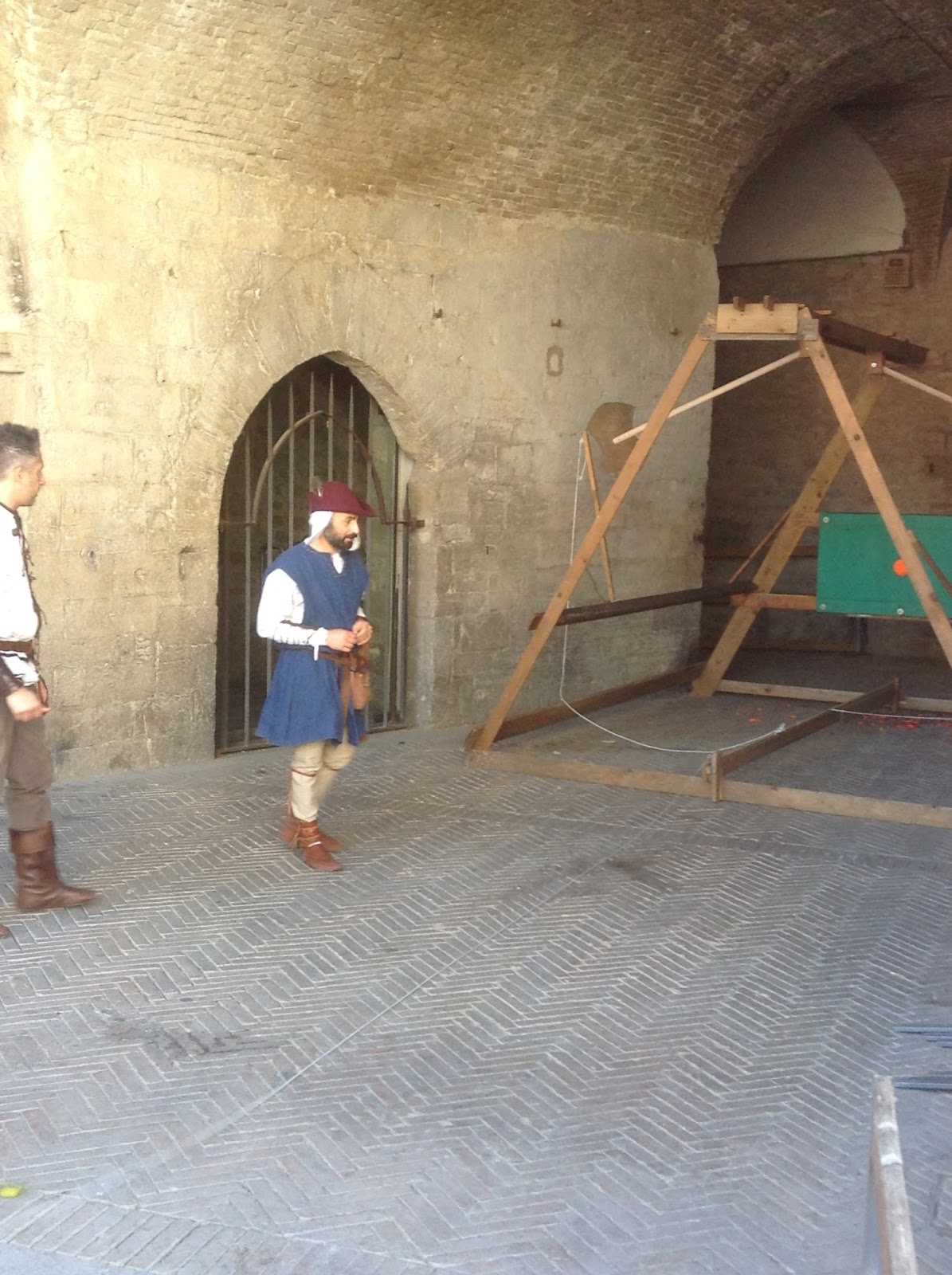
The highlight though was  the mid day archery competitions involving groups drawn from the four quarters of the town. Italian men and women do love to dress up and here was the perfect opportunity - outfits ranging from a knight in chain mail to a tonsured friar - both complete with bows and quivers of arrows. We couldn't help giggling at the some of these quasi-medieval outfits and the phrase "men in tights" couldn't have been more apt for this colourful display. In the main square the group were engaged in firing arrows through a makeshift swinging pendulum structure at the target behind and they were very skilled. The crown roared with approval when the bullseye was hit.

A TEAM BOWMAN FIRES AT A MOVING TARGET IN THE MAIN SQUARE
THE TARGET IS STRUCK THROUGH THE SWINGING PENDULUMS
OTHER COMPETITORS AWAIT THEIR TURN
Visiting these two Umbrian fiestas was an uplifting experience - a feast for all our senses and a reminder of the importance of cultural ritual based on history and tradition in these little towns. Not only do they bring the community together, young and old alike, they cement the present with the past and provide continuity in a rapidly changing world. At a time when modern technology and social media seem to be the principal reason for existence in the minds of many young people today - there was something ever so refreshing, heart warming and spiritually uplifting in these local fiesta events - long may they continue. As we walked back to the car we reflected on our perfect morning out and drove home looking forward to our well earned Sunday siesta? I wondered what the evening would hold later on??

Watch out for another posting related to Spello coming soon - its about a wonderful fresco cycle to be found in one of its churches by the renowned artist Pintoricchio.

Ciao & KBO
Ian


Sunday, 2 April 2017

MICHELANGELO'S SAN LORENZO LIBRARY, FLORENCE.

I'm back in Florence again today continuing the theme of Medici patronage introduced in the last posting. One of the things I love about the city is the fact its Renaissance history is perfectly encapsulated in its myriad of buildings which date from the 15th and 16th centuries. On every corner and down every atmospheric street there's something to see of significance and I'm also mindful of the fact that exterior facades are often misleading.

Just round the corner from Palazzo Medici, right in the city centre and on the edge of the market district, is the church and monastery complex of San Lorenzo. - The church used to be the Medici family's parish church. It doesn't look much from the outside (an external front facade was designed by Michelangelo but never built) but go inside and its a different story, for this is one of the most important church complexes in the city after the Duomo. In different parts of San Lorenzo its possible to see interiors and furnishings by some of the best known names associated with the Italian Renaissance and they are stunning. Not surprisingly books dealing with the history of western art nearly always feature them in some detail.

The unfinished front of the church of San Lorenzo

The San Lorenzo complex photographed from the top of the Duomo nearby
The aerial view of  San Lorenzo shown above reveals some of the different parts which make up the whole. In the centre of the foreground is the square void of the cloister of the monastery and the long tiered building to the right is the nave of the church of San Lorenzo with its unfinished facade visible in dark shadow. Beneath the tall square tower at the back of the nave is a shorter building sticking out to the left - this is the Old Sacristy designed by Brunelleschi and with interior decoration and tondo sculptures by Donatello. Beyond that is the long roof of the reading room of Michelangelo's Laurentian Library. The huge octagonal domed tower, which looks a bit like a miniature version of the Duomo, represents the core of the Medici Chapels housing the impressive hardstone tombs of  members of the Medici family by Matteo Nigetti. The green roofed building above the nave of San Lorenzo is the glass roof of the famous 19th century Florentine market halls.

The church is one of several in Florence claiming to be the city's oldest - it can trace its consecration back to 393AD and at one time in those early centuries it was the city's cathedral. In 1419, Giovanni di Bicci de Medici offered to put up the money for part of an ambitious proposed new church project to replace the old fashioned Romanesque church building that had been erected there in the 11th century. Filipo Brunelleschi, a relative new comer to architectural commissions in Florence at the time, was commissioned to produce the design and construction began on the Sacristy in 1419. By the early 1440's this was the only part of the church that been worked on in any detail as money for the rest of the project was in short supply. It was at that time that Giovanni's sons, Cosimo and Piero, came to the rescue with more cash and the nave was finally completed, with alterations, by 1459, thirteen years after Brunelleschi's death in 1446. It still wasn't finished though - side chapels were still being constructed in the 1490's.

The nave of San Lorenzo
Step in to the nave through the front entrance today and the interior space is serene and harmonious. The use of the dark grey pietra serena stone to articulate the proportioned and balanced structure, all against a plain white background, together with the simple geometric shapes of the slender perpendicular columns and semi-circular arches, draws the eye forward to the altar at the front of the basilica. Despite the alterations to Brunelleschi's original plans the building is thought by architectural historians to be a fine representative example of the new classical style that would dominate Renaissance architecture in the city from the middle of the 15th century.

Walk forward through the nave towards the alter and there are two must sees here.

The Old Sacristy by Filipo Brunelleschi 1421-1440
An exercise in geometetry, proportion and harmony in grey and white
Firstly - off the left transept is the entrance to the Old Sacristy - the earliest part of Brunelleschi's new church completed in 1440 and the place where the architect pioneered the ideas which characterise the main church which it was finally attached to in 1459. It's a perfect domed square with an integrated unity of elements and again the grey stone contrasts with the white walls emphasising the balanced and proportioned whole.

Old Sacristy Celestial Ceiling - San Lorenzo
Look up and the domed ceiling is painted with an early 1440's ceiling which depicts the sun and star constellations as they would have appeared on the night of July 4th 1442.They were restored in the 1980's. But the other notable feature of the interior is the decorative embellishments by Cosimo Medici's favourite sculptor Donatello.

Tondo relief - The Ascension of St John the Evangelist - polychrome stucco
Old Sacristy - San Lorenzo.
St Stephen and Saint Lawrence - above door stucco panel by Donatello
Old Sacristy - San Lorenzo
In the spandrels of the dome are circular low relief sculptures called tondi (singular tondo) which were made from stucco plaster and painted in shades of blue, white and terra cotta. They tell the story of San Giovanni Evangelista (St John the Evangelist). Over the tops of each of the arches are further painted stucco tondi (two colours this time) of the four Evangelists. Above the doors are Donatello panels, each with two saints. The one on the right depicts Saints Cosmas and Damian - the protectors of the Medici family. The family presence is also marked by the oval gilded Medici shields found beneath each of the spandrel tondi. Finally - we shouldn't forget the tombs in this room. In the centre - the tomb of Giovanni di Bicci de Medici by Buggiono and at the sides the tombs of Giovanni and Piero de Medici by Verocchio.

Back in the main body of the church we find two of the most famous objects to have come out of the early Renaissance in Italy - Donatello's famous pulpits - works droolled and poured over by students of the sculptor for decades. Essentially they are huge, bronze four sided oblong shaped boxes raised on sets of four marble columns (these are later in date and presumably reflect the fact the pulpits were raised on them in the 16th century). Get close to them and the sculptural details of the figurative scenes on the side panels of each are terrific. Both were made by Donatello between 1460 and 1465 towards the end of his career. They've been named the North and South pulpits, but the subjects matter on each has also meant they have been dubbed the "Passion" and "Resurrection" pulpits. If you visit they are worthy of detailed observation - see how many stories from the New Testament you can recognise. I'm moved to think these were the pulpits the firebrand priest Savonarola preached some of his sermons from in the late 15th century before he was finally arrested and burnt at the stake in the Piazza della Signoria.

The Passion Pulpit - San Lorenzo 
And finally we come to my last subject for this post. (I'm leaving the Medici chapels for a later blog) - Michelangelo's Laurentian Library - a sublime interior which I found jaw droppingly beautiful.

Bronze Relief Panel from the Resurrection Pulpit by Donatello in San Lorenzo 
I've mentioned before that many members of the Medici family prided themselves in their humanist values and collecting interests. The priceless manuscript collection, started by Cosimo de Medici and then built up by others and consisting of codexes, classical manuscripts, medieval works and others, was hugely important to them. In times of trouble the collection was requisitioned by the Republic in 1494 and placed in the library established by Cosimo at San Marco, but when the Medici returned to favour again and came back to Florence Cardinal Giovanni de Medici (later Pope Leo X) redeemed the manuscripts and took them to the Vatican for safe keeping.

But the Medici Popes always seemed set to establish their library legacy in their home city of Florence and the idea for a purpose built Florentine library for the collection had been around for a long time. Cosimo's son, Lorenzo de Medici (Lorenzo the Magnificent) had started a library project but work on it stopped at the time of his death in 1492. Legend has it that it was a spare piece of marble from this project which protoge Michelangelo carved his first sculpture from - the head of a fawn in 1490.

In 1523 Pope Clement VII - the former Giulio de Medici - wrote a letter via his agent Giovanni Fattucci to Michelangelo Buonarotti in Florence asking him to build a library  at San Lorenzo for the manuscript collection housed in the Vatican. It would be the artist's first proper architectural commission. Michelangelo produced many drawings for it (there were 15 batches of drawings in the first 6 months of 1524) and these would be sent to Rome for the Pope's comments. Clement took a great deal of interest in every aspect of Michelangelo's proposals sending his comments and own ideas back to him quickly. He commented on mouldings, the mortar to be using in the building, the construction of the foundations and even asked Michelangelo to be mindful of the type of wood he chose for the readers' benches - suggesting walnut for its longevity. The Pope loved novelty and wrote to Michelangelo - "a vostro modo" - "do it in your own way".  I love the story of Michelangelo proposing to the Pope that he used roof skylights to illuminate the reading room and the Pope wrote back "at least 2 friars will have to be employed to keep them free of dust"!

The finished result was and is a remarkable achievement and it certainly scored highly on the novelty index. Architectural historians have classified the library as a work of "Mannerism" - a style which affected all the arts in the middle of the 16th century including sculpture and painting. Mannerism was an intellectually driven style where artists deliberately sought to present the  user of a space or a viewer with challenging problems of separating the real from the imagined or possibly turning convention on its head or even setting out to create atmospheres of conflict and tension. Michelangelo's work at the Laurentian Library certainly satisfies some of these descriptive criteria for the style.

The library consists of a vestibule room with a staircase which leads up to the reading room which takes the form of a long oblong shape, Entering the vestibule room does produce a sensation of slight strangeness - the beautiful pietra serena elliptical staircase appears to flow right out in to the middle of the room instead of being conventionally set back. The walls punctuated with tall windows with classical moulded frames give the appearance or form one might expect to see on the outside of a building rather than on the inside. One author I consulted described it as being a bit like a building turned inside out and I thought this to be a good description of the feeling you get when entering the room. Interestingly Michelangelo's plans for the room broke the rules of classical architecture for the columns surrounding the windows and volutes beneath them are not structural elements and purely there for their visual effect. Climbing the stairs, which were completed by Ammanati in 1559 to Micehlangelo's designs, one reaches a huge monumental classically pedimented doorway at the top and then its the reading room itself.

Vestibule entrance - Laurentian Library - San Lorenzo
This is a huge room and quieter in feel to the vestibule - no doubt the intention of the artist designer.. Its also a room flooded with light from both sides. The balanced sequence of grey stone windows down each side of the room give a sense of harmony and rythm and contrast with the white walls. Each is ornamented with Medici devices and coats of arms relating to members of the family, Let no one forget who was responsible for this fabulous interior. There's a warm feeling cotto floor by Santi Bugliolo and a rather interesting carved ceiling executed by Bartista del Tasso. But the crowning glory are the Michelangelo designed furnishings in walnut as the Pope had wanted. This is a special place. It was incomplete when Michelangelo had to return to Rome in 1534 and it was finished off by Tribolo, Vasari and Ammanati under Cosimo the I's direction.It finally opened in 1571.

Vestibule Staircase from above

The Readiing Room, Laurentian Library - San Lorenzo
As you will have gathered I love this interior - I always think libraries make for interesting spaces for all sorts of reasons and this one is very special and one of my favourites.

The Medici Coat of Arms
There are set opening hours for the church and different parts of the San Lorenzo complex so check times and entrance charges on their website. The Laurentian Library is not always open so again research is needed to see what the situation is. My last minute advice - don't visit Florence without visiting San Lorenzo - its a gem.

Ciao and until next time - IAN


Tuesday, 28 March 2017

COSIMO DE MEDICI - MOVER AND SHAKER OF THE ITALIAN RENAISSANCE

COSIMO DE MEDICI - MOVER AND SHAKER OF THE ITALIAN RENAISSANCE AND A STUNNING BRONZE SCULPTURE.

In times gone by when I first showed an interest in the fine and decorative arts my studies concentrated on the 19th century in Europe and Britain in particular and I took little notice of the Renaissance period of the 15th and 16th centuries. My perceptions of the European world being one dominated largely by the church and its patronage with a legacy in our art galleries today of works with a religious subject matter was naive to say the least. Now its this very period that I find captivating and having the opportunity to visit Italy two or three times a year is just manna from heaven. So my posting today takes me once again to the Florence of the 15th century and introduces a man of extraordinary ability, capability and influence. Then it goes on to look at a work of art I've seen several times on my travels to Florence. It may have a religious subject, but as I intend to reveal here, it has a timeless value set firmly within a framework of Medici patronage and human achievement, creativity and excellence of a very special kind. It is quite simply both arrestingly beautiful and academically significant. Not surprisingly, in the history of western art books on the Renaissance always seem to give it special status.

Cosimo di Medici (1389-1464) is the man credited by many as establishing the illustrious Medici dynasty in 15th century Florence. His achievements were many. Firstly he further developed the banking network established by his father Giovanni di Bicci di Medici (1360-1429) and through this he amassed huge wealth and resources the size of which it would be difficult to envisage and comprehend even in today's avaricious world.  Secondly, by taking control of Florence's power bases and using them to enhance the family's status he quietly pushed his family in to pole position in such a way as to extend its influence throughout northern Italy and beyond. Thirdly, by pursuing a myriad of intellectual interests he became one of the movers and shakers of the Renaissance in Europe and deliberately created for himself a legacy which has lasted centuries.

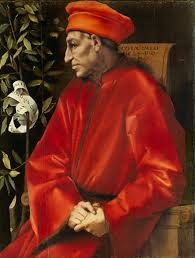
COSIMO DE MEDICI
by Jacopo Pontormo *
The laurel leaves, revealed in the background, became a symbol of the Medici family.
In 15th century Italy "humanism" was the slowly developing fashion for pursuing studies that illuminated understanding of the human condition and its potential - something very different to the Christian medieval view of a world where all was said to be controlled by divine forces and where everything was to do with the will of God. But in 15th century Italy the winds of change would blow strongly for it was a time of gradual but momentous intellectual revolution and rebirth. Cosimo de Medici would at the very heart of this new movement!

Initially the development of humanism was fuelled by the rediscovery of ancient classical literary sources - manuscripts which brought to life the works of Plato and many others. These had survived the "dark" ages in the libraries of monasteries in different parts of Europe and Byzantium and in the 15th century the mission was to discover and possess them. Cosimo, the fabulously wealthy Florentine banker, was able to fund a search for them and assist in those discovered being purchased and removed to Florence. Many of them would rest in his own personal library, but they were also studied seriously and often shared between scholars. Insights gained from them would profoundly influence the development of Florence in the 15th century - intellectually, politically, socially and in terms of the very fabric of the city itself through building commissions and art patronage.

To enlarge - by the time Cosimo was 30, from very small beginnings, he'd built up a collection of over 70 important books and manuscripts  He used an agent called Poggio Bracciolini as his intrepid scout and trips were made to many European cities as well as to places further afield in Greece, Syria and Egypt. Bracciolini had been letter writer to Pope John Paul XXIII and later became a major searcher of ancient manuscripts throughout Europe making trips to France, Germany and Switzerland. Not known for being the most scrupulous of negotiators he did however make an incredibly important find at the Monastery of St Galen in Switzerland where, in a tower dungeon, he uncovered a complete copy of DE RERUM NATURA "On the Nature of Things" written by Roman author and philospher Lucretius and lost since the fall of the Roman Empire. Based on poems by Greek authors it was to prove important in the development of early humanist thinking in 15th century Florence. Bracciolini would also prove influential in helping Cosimo realise his ambitions of becoming a major manuscript collector.

Sources also tell us Cosimo settled the debts of the eccentric dilettante and collector Niccolo de Niccoli after his death (he and Cosimo had been friends since his youth). The debt settlement was done on the basis he could gain control over Niccoli's huge ownership of over 800 important books and manuscripts. He would donate as much as half of these to a new project he started in Florence in the early 1440's.

 In 1444 Cosimo created the first public library in Europe in the Florentine monastery of San Marco - where he commissioned architect Michelozzo Michelozzi, a student of the illustrious Ghiberti, to oversee the restoration and development of a new Medici library there. The money provided by him funded not only the conservation and development work but in addition provided the funds needed to add more books to the ones donated from the Niccolo collection. Fortyfive copyists, hired by the bookseller Vespasiano da Bisticci, made further accurate copies of other important works to add to the collection.  It was ground breaking stuff.


TWO VIEWS OF THE MEDICI LIBRARY AT THE MONASTERY OF SAN MARCO
IN FLORENCE (open to the public)
Cosimo's patronage of architecture and the arts included the following:
  • The Palazzo Medici, the archetypal Florentine palazzo - designed by Michelozzo Michelozzi
  • The commissioning of the fabulous fresco cycle in the Magi Chapel by Benozzo Gonzoli (completed in 1461 - see blog posting number 3 done in 2015)
  • Completion of the dome of Santa Maria del Fiore by Brunelleschi. 
BRUNELLESCHI'S DOME ON THE CATHEDRAL OF SANTA MARIA DEL FIORE
Part of Cosimo di Medici's legacy to the city of Florence
And then there was the David sculpture!! - the work of art I set out to write about at the beginning of this posting!

This patinated bronze figure of David, of David and Goliath fame (Book of Samuel Ch 17), is housed in the Bargello - Florence's museum of sculpture which can be found in a monumental building, once a prison and located behind the Piazza della Signoria. It's a cast bronze figure modelled in the form of naked young man (apart from a brimmed hat and calf length boots), with hand on hip and with his other hand holding an over-sized sword - the one he used to slay the Philistine giant - Goliath. The deed has been done and his right foot rests on the large severed helmeted head of the giant. The figure has an enigmatic smile on his face.

"David" by Donatello - 1440's
Bargello Museum, Florence.
The bronze casting and craftsmanship is superb and the figure is famous for being, according to most art historians, the first free-standing, unsupported male nude to be cast in bronze since antiquity. Many art historians, (but not all it has to be said for the figure is undocumented) believe the figure was commissioned by Cosimo di Medici from the upcoming Florentine Renaissance sculptor Donatello who he knew well. The date is probably the 1440's and its thought to have been a private commission made to stand on a pedestal in the centre of the recently completed courtyard of the Palazzo Medici. The statue was certainly recorded as being there by Vasari in the 16th century. Though there is no paperwork to support this theory - the laurel band on David's head would suggest a Medici commission. The laurel was one of the personal emblems of the Medici as seen in the Pontormo painting shown earlier in this posting.

Rear view of the Donatello bronze "David"

The earlier marble "David" by Donatello completed in 1409 which is much stiffer
 and more 'gothic' in character than the one we have been looking at. 
The iconography of the statue is on one level obvious - the young hero of the Israelites has slayed the mighty giant of the Philistine army, but on another level it is enigmatic and controversial. This figure is realistic and in it Donatello has captured a slender, vulnerable and effeminate young man - not exactly an alpha male and a huge contrast with the "manliness" of Goliath as its revealed in the huge severed head. The youth has overcome the giant not through physical capacity and capability but by other means which art historians have speculated on for decades. One curious aspect of the composition is that David stands on one of the two wings found on the helmet of Goliath, but the other longer wing appears to work its way up David's right leg towards his groin. Was this then a a coded message of a homoerotic nature perhaps signifying the known homosexuality of the sculptor or is there a more subtle meaning to this enigmatic work? At the time the statue was made homosexual acts were criminal offences, though the practice was common amongst young men in a society where casual sexual acts with young women were off limits to most. Whatever the case - the statue would have been perceived then as edgy in nature I feel sure. As a sculpture of male figure however it shows a distinct shift in Donatello's work for he made two statues of David - the earlier one in marble - which somehow lacks realism and doesn't convey the emotion and personality of the later one.

As I said - this early "humanist" statue can be viewed in the Bargello, but there is a plaster cast copy in the Renaissance Cast Court at the Victoria and Albert Museum in London. It's surprisingly good.

This has been a fascinating post to put together and I've enjoyed doing it. It's once again revealed to me the importance and broad-ranging interests and ambitions of Cosimo di Medici as one of the most important movers and shakers of the early Renaissance in Florence.

Ciao and until next time
Ian

* - the Pontormo painting of Cosimo di Medici was done some 50 years after his death in 1464. According to one author it may have been made from sketches contemporary with Cosimo's life which have not survived. You can make up your own mind, as I have tried to do, what qualities of personality and emotion the artist has captured in the work.


Saturday, 18 March 2017

HANNIBAL IN UMBRIA - THE STORY OF A FAMOUS VICTORY

WHAT HAS HANNIBAL GOT TO DO WITH UMBRIA'S LAKE TRASIMENO??

During our recent week in Umbria it rained a lot causing us spend more time than usual indoors. On one particular wet afternoon I got out the collection of old DVD's to choose one to wile away the afternoon and came across "Gladiator" which I haven't watched since it first came out. The story was cliched and familiar but I remembered it as an entertaining film. Whilst watching some of the Coliseum enactments mention was made, by the Master of Ceremonies I think it was, of the famous battle between the Romans and the Carthaginians in 217BC - a battle that the Romans famously lost. I'd forgotten that it took place just a few kilometres away from where I was sitting watching the film. Though I wouldn't describe myself as an avid fan of Roman military history I decided it was time to go and see where the famous confrontation took place. We made a decision to go the next day if the weather held up.

The battle site is located near the present day town of Touro on the northern shores of Lake Trasimeno just a 30 minute drive from our place and though we'd circumnavigated Italy's third largest lake on several occasions, we'd never stopped to discover more of this famous battle which played such a significant part in the second Punic war. Just outside Touro there's a pull-off by the road which gives a great vantage point of where the battle was fought.

March 2017 - a look out spot for viewing part of the battle site of Lake Trasimeno
There were two Punic wars fought between the Romans and the Carthaginians during the period of the Roman Republic. In the first, which ended in 241BC, the Carthaginians lost Corsica, Sardinia and Sicily and many other smaller islands to the Romans, - an economically disastrous result for the North Africans. The Phoenician city of Carthage didn't fall to the Romans however and it was from this ancient north African city that military retaliation against the Roman Republic was planned.

First the Carthaginians expanded in to southern Spain, a move not initially opposed by the Romans; they had plenty on their hands at the time attempting to control the tribes in Gallic and Germanic Europe. The Carthaginians, led by Hannibal the son of Hamilcar Barca, one of the great military leaders in Carthage, then moved on the Spanish city of Sagunto. and under Hannibal's army largely destroyed it. When the Romans decreed the city should be turned over to them, this became the official reason for the start of a second Punic war in 219BC.

Artist's impression of Hannibal crossing the Alpes with his army
and a herd of elephants
Hannibal, a clever, shrewd and tenacious military leader and tactician, had experience  and a reputation for using complex, intelligent and unusual strategies to defeat enemies superior in numbers. He had the capacity to cleverly assess the strengths and weaknesses of an enemy and play to his own strengths - all tactics he would use in the Battle of Lake Trasimeno.

A marble bust reputedly of Hannibal discovered in Capua, Italy. 
Sources reveal he decided to approach Italy by land, rather than crossing the Thyrrenian Sea - believing he might be able to stir up trouble and gather support for the war en route. His journey actually began in 218BC with an army of 50,000 men, 9000 horses, and 37 elephants and his route would involve crossing the Pyrenees and the Alpes. Who hasn't heard the story of  Hannibal taking these mighty beasts over the snow capped mountains? Sadly - most of them appear to have been lost during the journey. He went on to defeat the Roman armies at  the two great battles of Ticino and Trebbia and after crossing the Apennines he finally ended up in the vicinity of Lake Trasimeno in Umbria where he knew he would have to face up to Roman armies under the command of Consul Caius Flaminius. He had already been defeated by Hannibal but had been shadowing the victor's path with his army for some time. He believed a victory here would bring him the support of the Etruscans and perhaps the opportunity to take on Rome itself.

Hannibal considered the natural shallow basin, entered by a narrow valley with hills on one side and close to the northern shores of the lake on the other, a suitable place for an ambush and hearing that Flaminius was following his tracks he made preparations for another battle. He set up camp on the shores of the lake and developed his strategy. Below the camp he placed his heavy infantry on the top of shallow hills. Above the camp - on the heavily wooded hillside close to the valley where the Romans would come he concealed his cavalry so they could cut off any Roman retreat. Other troops were posted at points overlooking the basin with orders to keep themselves concealed in the woods. In addition Hannibal ordered his soldiers to light camp fires on the hills close to Touro to convince the Romans that his forces were further away than they actually were. Hannibal had cleverly set up an ambush site where the Roman armies would be surrounded on all sides and not easily able to retreat in any direction. They would be forced up against the waters of the lake in fact where Hannibal figured they could be finished off.

The Roman approach is marked in red, Hannibal's positions in blue.
The battle took place on the morning of June 24th 217BC (April in the Julian calendar) and the Romans approached from the west in fog. When they entered the narrow valley and the ensuing shallow basin Hannibal gave his troops the order to attack and his forces came down on the Roman armies swiftly so they had no time to form up - forcing them to fight in chaotic fashion - something they were not used to having to do. They were soon driven back to the lake shores from which there was no escape or return. In a matter of four hours most of the Roman army was wiped out. 15,000 Roman soldiers, including their Consul leader, were killed. A local myth says that because of the field of blood the stream which flowed through the area was renamed Sanguineto - Blood River. It was a tremendous victory for Hannibal and the Carthaginians and caused chaos back in Rome. Though Hannibal would never manage to attack and take the eternal city, he would occupy much of Italy and be at war with the Romans for another fifteen years. Only then would he be recalled to Carthage to engage in battle with the Romans at what would become the battle of Zana where he would be defeated once and for all by Scipius Africanus.

Artist's impression of the defeat of Flaminius's army on the shores of Lake Trasimeno
Hannibal is considered by many authorities on Roman history "to have planned and executed one of the greatest ambushes in history". Quite simply he is revered as one of the best military commanders ever to have lived and his planning and tactical methods have been much studied down the centuries.

The tranquil shores of Lake Trasimeno - the site of the battle - in March 2017
Today, from various vantage points, its possible to see the shallow basin where the massacre of the Roman soldiers took place, but in the quiet cultivated landscape of today there's little in the way of tangible evidence to reinforce the story I've told. The reconstructive evidence has largely come from literary sources. The other complicating factor concerns the fact that there have been conflicting theories about where exactly the shore of the lake was at the time of the battle as Lake Trasimeno has expanded and contracted in size at various points in time. Despite the arguments and the holes in the evidence however, this place remains an important battle site in the history of the Roman Republic and its story a testament to a Carthaginian General who has entered the realms of myth and folklore. Google "Hannibal" and one discovers a whole list of references to films, drama series and documentaries based on the career of this most illustrious of military characters. To tell you the truth I knew little of Hanniabal (other than the story about the elephants) before doing the research for this blog posting. Now I know not only a bit about him, but also quite a lot about the Punic Wars and their importance in Roman history. I felt privileged to have visited this evocative historical site. What a wonderful retirement hobby blogging is - I can recommend it!!

THERE ARE OVER 90 POSTS MAKING UP THIS BLOG WRITTEN OVER SEVERAL YEARS - I HOPE YOU WILL TAKE A LOOK ATA SOME OF THE OTHER LISTINGS OR EVEN CONSIDER BECOMING A FOLLOWER THUS HELPING ME KEEP THIS BLOG ALIVE. CHEERS - IAN 


Friday, 10 March 2017

SAN GIMIGNANO - A TUSCAN TOWN WITH A PHALLUS COMPLEX?

SAN GIMIGNANO - THE TUSCAN MEDIEVAL TOWN OF THRUSTING TOWERS - WHO SAID SIZE DIDN'T MATTER?

It's been a while since my last post and I apologise for that, but now spring is here and hopefully its back to regular updates for my Italian blog. We've just had a short spring break in Umbria, but this time the weather wasn't good with lots of wind and rain. If the amount of rain that fell in the last few days is typical of this time of year, then there's no wonder they call the region "the green heart of Italy". On the day we arrived and on the day we were leaving however, the sun shone and the skies were the most amazing azure blue - a reminder that the local weather can be balmy even in March. This time we were flying home in the early evening from Pisa so we decided to leave Umbria mid morning and have lunch in one of our favourite Tuscan hill top towns - San Gimignano - just over an hour's drive from our place near Castiglione del Lago.

The route took us up the A1 motorway for a short while and then we turned left to head for Siena, by passing the town when we got there and taking the quieter road northwards in to the beautiful Tuscan countryside. Smoke was billowing from field fires in several places as owners pruned their olive trees and burnt the branches and there was much activity in many of the hillside vineyards as the plants were being prepared for the forthcoming spring growth surge. In this age of modern technology, where I was following our route as a blue dot passing along the route on my mobile phone, I celebrated that what I was seeing out of the window was a bucolic scene that had changed little over the last few hundred years. There's something very reassuring about that. It didn't seem long before we'd reached the brow of a hill and there in front of us, sitting on top of a fold in the landscape in the spring sunshine, was the  town of San Gimignano - renowned for its many tall towers and one of the most distinctive and famous skylines in the whole of Tuscany.


TWO VIEWS OF SAN GIMIGNANO
After driving up the narrow winding road to the town (goodness knows what its like in summer!) we parked the car in an ultramodern car park outside the city walls near the 13th century gateway - the Porta San Giovanni. Today, thankfully, only locals and delivery vehicles are allowed inside the walls during the day time. (One of my friends in the States told me recently she'd spent time in the town in 1982 whilst on honeymoon and driven through the gate all the way up to the main square where she and her husband had parked the car and then gone to find a room for the night!) No need to worry about being mown down by a Vespa on this occasion.

PORTA SAN GIOVANNI
Though the narrow main street is today lined with tourist shops selling artisan foods, ceramics and knick knacks - it's incredibly atmospheric and despite lots of visitors, even at this time of year, the experience is one of stepping back in time. It's easy to let the imagination run riot and think of the colourful hustle and bustle there would have been on a street like this in times gone by. Like many other hill top Tuscan towns - the route is a spinal one, gently leading up to the main square and as one passes along it, its possible to catch glimpses of the glorious Tuscan countryside through the narrow alleyways that lead off it on both sides of the street. I remembered to look out for the partially original 13th century Romanesque facade of the church of San Francesco on the right hand side.

FACADE OF THE FORMER CHURCH OF SAN FRANCESCO
At the top of the street we entered the picturesque Piazza Communale and stopped to catch our breath.
PIAZZA COMMUNALE WITH THE TOWERS
OF THE ARDINGHELLI FAMILY CLEARLY VISIBLE
San Gimignano can trace its origins back centuries and by the early medieval period it was already well fortified. It had flourished on the back of trade in saffron harvested from the brightly coloured crocuses grown in the local area. Its position on the Via Francinega from Rome at a point where it intersected with a road to Pisa was geographically a good one. Originally under the church's control it became a free commune in 1119 and for the next 200 years it grew and prospered until 1315 when the European pandemic of the Black Death, coupled with poor harvests and family feuds caused its growth to falter so it had to ask Florence to administer it in return for protection. The gradual decline in its prosperity over the ensuing centuries protected it from future development meaning that in the modern age the city street plan and much of the urban fabric largely remained unchanged. As visitors we benefit from this aspect of its history and today it is listed as a UNESCO World Heritage Site.

ANOTHER VIEW OF THE PIAZZA COMMUNALE
There are many Tuscan hill top towns with a similar urban plan to that of San Gimignano - Montepulciano comes to mind just along the road from where we have our place - but what on earth caused the explosion of tower building in this one? Well - it would appear that essentially it was a huge medieval willy-waggling competition. Local, wealthy families, often in conflict with one another in the town, flaunted their power and status through tower building. By the 14th century there were 72 towers would you believe, though only 16 are still standing today. The buildings from which the demolished towers sprang up are still there. Sources indicate that many of the towers were inhabited and had wooden balconies and outside landings with staircases down to the ground.The Rognossa tower in the main square, 51 metres tall, was one of the tallest and the site of the local administration in the medieval period.

THE INTERIOR OF OSTERIA SAN GIOVANNI
VIA SAN GIOVANNI
We spent lunch time in a wonderful little restaurant on the main street just below the square. We were the only people there and the pasta dishes - home made lasagna and a wild boar stew were beautifully served and delicious - not too bad on price either for a restaurant on the main tourist drag. Not surprisingly it was called Osteria San Giovanni and I would definitely recommend it. The second treat came shortly afterwards when we decided to have an ice cream before going back to the car. We retraced out steps through the Arch of the Becci (previously a gate in the original 10th century city walls) back in to the square and there, behind a narrow frontage, we rediscovered one of the best gelato shops in Italy - Gelateria Dondoli. The choice of flavours was a huge mouthwatering display and I chose a carton with a medley of three flavours, pistacchio, dark chocolate and pink prosecco, Jon had a cone with his two favourites on top - all for the  princely sum of 6 euros. The photographs speak for themselves. I'd return to San Gimignano anytime just to come to this little ice cream shop!


If you visit San Gimignano there's lots more to do than just wander the streets - though that in itself is a rewarding experience. Here are a few other suggestions:

Collegiata di Santa Maria Assunta - built in the 12th and 13th centuries - in the man square. Full of works of art including a fresco cycle telling the story of Santa Fina by the renowned Renaissance artist Ghirlandaio.
The Museum of Sacred Art - full of works from the collegiate and other local churches.
The Museum of San Gimignano which includes a large scale model of the medieval town.
The Palazzo Nuovo del Podesta - dating from the late 13th century, which includes the Torre Grossa - the highest tower in the town and the only one that can be visited. The palace includes the Museo Civico.
The church of Sant' Agostino which has a rather special cloister and an interior with lots of works of art.
CIAO FROM SAN GIMIGNANO
For us it was time to head off to Pisa for the early evening flight to Stanstead. So if you haven't been to San Gimignano - put it on your Italian bucket list - I don't think it will disappoint - whatever time of year you choose to go there.