Monday, 14 August 2017

THE PICCOLOMINI LIBRARY IN SIENNA CATHEDRAL

It's back to Siena for this month's post and I've just remembered that its coming up to a year since we took some friends to see Siena Cathedral. I wrote about the fantastic inlaid marble floor in an earlier post but saved one the most glorious aspects of the cathedral's interior for the post I'm writing today. The other thing I've just recalled is the connection between a post from a few weeks ago when I was writing about the artist Pinturicchio in connection with work he'd done on a chapel in Spello and the work the artist did here in Siena Cathedral - the commission which is the focus of this post.

FRONT FACADE OF SIENA CATHEDRAL 
To visit Siena Cathedral is an overwhelming experience for there is so much to see and take in. It's a feast for all the senses and no more so than in relation to the library contained in a room off the left hand side of the nave. The transition from the relatively dark main body of the church to the jewel like interior of this sublime space is a memorable moment in itself (savour it when you visit) for its like walking in to a fantastically coloured jewel box and it is quite simply stunning. So where did this magnificent interior come from - who was responsible for it? and what was its purpose?

THE PICCOLOMINI LIBRARY 
Well firstly the name Piccolomini Libarary is a useful starting point. The room was constructed as a dedicated space for an important collection of humanist antique and medieval manuscripts collected by Pope Pius III of the the Piccolimini family who originated from the small town of Pienza in Tuscany not far from Siena. In fact when it was completed the manuscript collections were never housed here and the space has since become famous for the artistic scheme of decoration carried out by Pinturrichio for Pope Pius III. The Pope had wanted a room dedicated to his famous uncle's memory and a fresco cycle which would tell the story of his life.

This Uncle was a man named Enea Silvio Piccolomini who came from a relatively humble background in the Val d'Orcia, entered the church as a priest and rose to become firstly an important diplomat within the Vatican hierarchy and then later a Cardinal and finally becoming Pope Pius II. As a diplomat Enea had played an important role in leading negotiations between the Pope and King Frederick III of Austria, also playing an important part in brokering the marriage between the Emperor and Elonora of Aragon and making arrangements for his coronation as Holy Roman Emperor in Rome itself in 1452. Rising rapidly through the ranks of the catholic church on the back of his achievements, he was made a Cardinal in 1456 and elected Pope just a couple of years later in 1458. He died in 1464.

The Cathedral library dedicated to this Pope was painted and decorated by Pinturicchio (Bernadino di Betto) between 1502 and 1508. The main frescos, in ten large compartments, relate stories from the Pope's life, illustrating such subjects as Ennio Silvio paying homage to the new Holy Roman Emperor, presenting Eleonora of Aragon to Frederick, him becoming a cardinal and his election of Pope. From the first scene at the far end on the right wall where Enio is depicted as a young boy, he gradually ages through the stories. Pinturicchio makes splendid use of all the modern Renaissance techniques of perspective and modelling of the human form to present beautifully costumed figures in brilliant colours set against a combination of real and imagined landscape backgrounds. Latin inscriptions provide titles for every scene in panels at the base of each one. To view a panel fresco is to look through a window at a scene taking place in the foreground, the eye then cleverly drawn through to the far distance beyond. Each one is beautifully composed, balanced, harmonious and worthy of detailed attention down to the finest details.

ENNIO PICCOLOMINI AS AMBASSADOR TO THE COURT OF
JAMES I OF SCOTLAND 
The depiction of the stories themselves though is only part of the overall decorative scheme for the compartments are separated by painted decorative "grotesque" pilasters inspired by the decoration uncovered in the excavations of Nero's Golden House (the Domus Aurea) in Rome. Each is also framed by wonderfully illusionistic arches. The vaulted and compartmented ceiling is amazing, painted in red, blue and gold again with lots of fashionable Roman ornament surrounding the painted scenes in the small panels. Not surprisingly the papal arms feature in the centre of the ceiling. You might want to take a small pair of binoculars with you to look at these. Oh and don't forget to take a look at the sculpture of the Three Graces in the centre of the room - its a Roman copy of a Greek original.

HOMAGE TO POPE EUGENIUS IV
IN THE NAME OF EMPEROR FREDERICK III
This stunning interior was surely Pinturicchio's finest achievement. The room, relatively recently restored, is another Siena "must see" experience and you can discover details of the opening times and charges for the library on the cathedral's website.

Ciao & KBO
Until next time
Ian


Thursday, 3 August 2017

THE MEDICI SWAN HUNT TAPESTRY FROM THE VILLA POGGIO A CAIANO, TUSCANY

THE SWAN HUNT TAPESTRY

I've always been intrigued by tapestries - by their aesthetic beauty, the skill involved in making them, the time it took to produce them and their significance as social documents. I was delighted to find an unusual one on display at the Medici Villa -  Poggio a Caiano when we visited in June. It was titled "The Swan Hunt" and I took great pleasure in examining it in detail. It's shown below.

THE SWAN HUNT TAPESTRY ON DISPLAY AT THE MEDICI VILLA POGGIO A CAIANO
Tapestries have been important art forms throughout Europe since the medieval period and were always hugely significant, not just as wall insulation but as elite, status objects - often worth more than the entire contents of an important property. When I first started seriously studying the history of the decorative arts I remember being drawn to them and was fascinated to discover that when an owner moved from one of his properties to another (this was often the case in medieval Europe) - the tapestries were taken down, rolled up and carefully moved to the next house to be displayed there. It amazes me that so many have survived through to the present day given their fragile nature and sensitivity to light, but the fact that they have been treasured over the ages is testament to their importance as unique art objects.

Tapestries were commissioned with a design or set of designs being produced by an artist for the patron and when this was approved it was then translated in to a full size cartoon which the weavers would work from to produce the tapestry. Weavers sat in front of a loom strung with vertical woolen threads (warp threads) and looked through these to the cartoon behind. Laboriously the weaver would then insert vegetable dyed coloured weft threads of wool and often silk to make the picture. The weaving process took place from the back so the final image was a reverse image of the one on the cartoon. It would take months and sometimes years to weave the picture which might be one of a set.


SCENES OF CONTEMPORARY TAPESTRY WEAVING DEMONSTRATE
TECHNIQUES WHICH HAVEN'T CHANGED IN CENTURIES
Tapestry making workshops were set up in areas important for commissions from wealthy patrons. In the 15th century there were significant centres in France at Arras and Tournai and also in Brussels which became dominant in the late 15th century. In Italy tapestry works were created in Mantua and Ferrara in the early 16th century, but it was not surprising that the Medici family would want to get in on the action and a tapestry making workshop was set up by Cosmio I de Medici in Florence in 1545. Output from it was not huge but the workshop concentrated on quality production and innovation in design. The tapestry I viewed at Poggio came from this workshop.

Subjects for tapestries in artistic terms ranged from the depiction of biblical stories, to narratives from classical mythology as might be expected but from the medieval period onwards contemporary subjects focusing on the countryside, forests and the practice of hunting were always popular. Hunting was the sport of kings and the elite and was thus suited to the production of these status objects. Anyone who has not seen the set of Devonshire Hunting Tapestries which are in the Victorian and Albert Museum should book a train ticket to go and see them today!! As mentioned earlier - sets with a selected theme were the norm and the highest elevation of the art in terms of status.

Our Swan Hunt Tapestry was part of a set of 36 hunting scene tapestries produced by the Medici workshops between 1566 and 1582. They were woven from cartoons by two artists - Giovanni Stradano (who did the majority of the designs) and Alessandro Allori (who did a small number of them). They must have been important from the start as contemporary 16th century art historian Giorgio Vasari described them as "bird catching scenes". They appear to have been commissioned as a tribute to Lorenzo de Medici, the founder of the Poggio villa, who had a great interest in hunting and who also wrote a poem entitled "Ucellagione di Starne" (catching partridge) but also known as "Caccia col Falcone" (falconry). The original concept seems to have been compromised though at an early stage with some of the tapestries showing scenes involving the hunting of a wider range of animals but when Francesco I came to the fore the weaving turned again to birds and four tapestries designed by Allori were woven of which this was one. Fragments of two of the others (Wild Goose Hunt and Wild Duck Hunt) survive in Siena but the fourth (Heron Hunt) has been lost.

Swans (definitely a non PC subject today) were hunted by the elite for many centuries and their meat was considered a delicacy in many European courts. In England, during Elizabeth I's reign, swan was a popular feast dish and birds would be magnificently displayed on the banqueting table packed with other roasted birds inside them and stuffed!

This tapestry shows swans being hunted with guns and dogs. The image shows a man with a matchlock gun - a type of weapon widely used in hunting during the 16th century.

DETAIL OF THE MAN WITH A MATCHLOCK GUN POINTING AT A FLOUNDERING SWAN 
Though my photographs don't reveal it too well - the borders of the tapestry make references to Lorenzo's poetry and his interests in falconry. In the upper corners of the border there are two men with falcons on their arms and at other points there are 2 pairs of falcons perched on medallions. In the "Wild Goose Hunt" tapestry - falconry was the main subject theme.

Today these images depict a narrative which is abhorrent to many and swans are thankfully protected in many countries, but considering the subjects of the tapestries in context provides a fascinating insight in to courtly life in a society where hunting birds was a prestigious and important activity. Viewing a tapestry is truly a look through a window into a forgotten world where the written word doesn't do it justice.

As I said earlier - viewing tapestries is satisfying on a whole variety of levels. I hope the subject of this one doesn't cause offence!!

Ciao and until next time
Ian


Tuesday, 1 August 2017

POGGIO A CAIANO - A RENAISSANCE HOLIDAY PAD UNDER THE TUSCAN SUN

THE MEDICI VILLA - POGGIO A CAIANO

I'm still absorbing and digesting the wonderful experiences we had on this year's June trip to Umbria and Tuscany and I don't mean the swimming pool and the wine though thinking about it they were quite nice too! On the final day of our short stay we'd arranged to fly back from Pisa airport - about a two and a half hour drive from our place near Castiglione del Lago. The flight was an afternoon one leaving us plenty of time to take a leisurely drive northwards and a great opportunity to fit in a visit to a site of special interest on the way. From the options I'd thought about there really was only one choice - an exploration of a magnificent Tuscan villa I'd read about outside Florence whose history could be traced back to Lorenzo de Medici's "get away from it all" commission for a summer home away from the heat of the city.

Precedents for holiday homes in cooler climes are not difficult to find in the Italian peninsula. Many Roman senators had villas on the slopes of Mount Vesuvius on the Bay of Naples and I couldn't help but recollect a visit I once made to Emperor Hadrian's glorious villa at Tivoli outside Rome.The Pope's summer residence at Castel Gandolfo south of Rome has been in use since the early 17th century. In Renaissance Florence, where the heat could be fierce in Summer, lots of important members of the elite sought Summer respite in the hills round the city in towns like Fiesole. Cosimo de Medici, the recognized godfather of the Medici dynasty, spent many a summer at his villa in the hills outside the city.

THE VILLA POGGIO A CAIANO OUTSIDE FLORENCE
Commisioned by Lorenzo de Medici in 1485
Cosimo's grandson Lorenzo Medici (Lorenzo the Magnificent) commissioned a holiday home outside Florence from the Italian sculptor, architect and military engineer - Giuiliano da Sangallo in 1485. Sangallo had worked for Lorenzo by building military fortifications and managing artillery in the town of Castellina to fend off attacks from the Duke of Calabria with a good degree of success. Despite having attempted to hold a competition for the villa project to find the best architect, Lorenzo went with the man he had come to know and respect. Sangallo used Alberti's design for a villa in Fiesole as a source of inspiration, but the one at Poggio would be more ambitious and involve a greater degree of creativity in its attempt to fuse Tuscan vernacular with principles of architecture derived from antiquity. Though the villa remained incomplete during Lorenzo's life and would be finished by his son Giovanni who became Pope Leo X - today its exterior remains largely as it was in the early 16th century. The only major change to have taken place is the removal of the original exterior staircase to the first floor and the installation of a curvaceous replacement one in the early 19th century by Pasquale Poccianti.

MODEL OF HOW THE VILLA LOOKED AFTER ITS COMPLETION
c1520 - the original staircase was replaced in 1807 with the one seen now
The main block is surrounded by a porticoed terrace with a tunnel vault beneath, finely decorated in relief. At first floor level the terrace frontage is dominated by the portico - the classical temple like structure complete with columns and pediment. Between the top of the columns and the pediment a frieze incorporates a wonderful blue and white glazed terra cotta series of relief panels attributed to Andrea Sansovino and with figurative scenes inspired by mythology and telling stories related to themes of "the Cycle of Time", "Eternity" and "the History of the Soul". Though the originals have been replaced with reproductions there is a room inside the villa where the original frieze can be viewed in detail at eye level.

PART OF THE ORIGINAL GLAZED TERRA COTTA FRIEZE
FROM THE TEMPLE PORTICO OF POGGIO A CAIANO
Inside the story is rather a different one for there have been significant changes to the interior decor and use of the various spaces. Many alterations were introduced when the villa became the summer residence of King Victor Emmanuel II. What I do want to focus on though is the survival of an interior space which does remain intact, both to the original architectural scheme by Sangallo and to the work done on the property by Pope Leo X, Lorenzo's son. The room is named after the man and lies at the heart of the villa on the first floor - the "Salone di Leo X". Oblong in shape and extending the full width of the villa with windows at both ends, it replaces what would have been a courtyard space in a traditional Tuscan villa of the 15th or 16th centuries.

THE BARREL VAULTED CEILING OF THE SALON OF LEO X
The Pope's heraldic device can be seen at the centre of the ceiling
A huge barrel vaulted ceiling makes the space incredibly impressive and grand and its an architectural form again derived from antiquity. Even in its construction, which made use of fitted together moulded elements in to which concrete was poured. is derived from Roman sources and made use of by Sangallo in 1485. The decoration of the room is later and related to the scheme commissioned by Lorenzo's son Giovanni, after he was elected Pope Leo X in 1513. The ceiling is decorated with moulded and sculpted stucco (plaster work) which incorporates many Medici emblems - at the centre of which is the device of Pope Leo himself.

FRESCO OF ONE OF THE "VIRTUES" ABOVE A
DOORWAY IN THE SALON OF LEO X
The wall decorations are in colourful fresco (painted plaster) and celebrate Cosimo the Elder de Medici and Lorenzo the Magnificent by allying them with figures and narratives from classical mythology. Over the doors and windows for example figures representing the "Virtues" take central stage. On the walls frescoes concerned with stories such as "The Return of Cicero from Exile" by Franciabigio.

On each end wall the half circle lunettes are decorated with two stories - "Vertumno and Pomona" by Pontormo and "Hercules in the Garden of the Hesperides" by Allori. The latter (shown below) relates to Hercules's 11th labour where he was asked, against all odds, to retrieve the golden apples belonging to Zeus kept in a garden at the northern end of the world. It's probably an allegory for one of the Medici family "achieving the impossible" but its depiction here is a light-hearted representation of the story in a bucolic garden probably meant to suggest the one surrounding the villa.

LUNETTE DECORATION IN THE SALON OF LEO X
Hercules in the Garden of the Hesperides
It's clear that this room had one purpose and one purpose only - the achievements and glorification of the Medici dynasty and though we see it today as being pompous in the extreme - its a rare, beautiful and major survival of an art installation that reflects not only the achievements of important Renaissance architects and artists, but as a fine example of the use of art to aggrandise and glorify this most important of families in the Italian High Renaissance.

I hope Donald Trump doesn't get similar ideas for the White House though!! I can't imagine what would appear on the ceilings there!!

Oh - and I forgot to mention - when you turn up to view this magnificent villa - there is no entrance charge. Check the internet for opening times as they are restricted.

Ciao and KBO
Ian


Saturday, 8 July 2017

SPELLO - DISCOVERING A SPECIAL FRESCO CYCLE BY PINTURICCHIO

A BEAUTIFUL FRESCO CYCLE IN THE CHURCH OF SANTA MARIA MAGGIORE - SPELLO

One of the special things about visiting Italy is the sheer delight to be had in visiting its towns and cities. Not only does each one have multiple layers of history and a special atmosphere to boot, endless possibilities for local food and wine (this is especially true in Umbria) - and there is usually something art historical to be enjoyed as well. Indeed many of our trips and days out have been motivated by the seeking out of a morsel I've read about in one of my books on Umbria and Tuscany. This proved to be the case in June 17 when we visited Spello to see the Carpet of Flowers festival written about in the last posting. I knew there was a very special fresco cycle to be viewed in one its churches.

A third of the way up Spello's steep main street, the Via Cavour, is the town's Santa Maria Maggiore church. This ancient building. which dates back to 1285 and much altered and added to in later centuries, was constructed on the site and foundations of a Roman temple dedicated to Juno and Venus.

THE CHURCH OF SANTA MARIA MAGGIORE - SPELLO
The two Roman columns can be seen at the foot of the bell tower.
Clues to its Roman origins can be seen outside where the remains of two columns from the original temple stand at the foot of the bell tower to the left of the Baroque 17th century entrance to the church. Inside there are further reminders of the Roman heritage in some of the church furnishings. The font, for example, was made from a Roman funerary altar dedicated to Roman magistrate Caius Titienus Flaccus; his portrait is revealed in one of the relief panels on the side of the font.

CHURCH FONT MADE FROM A ROMAN TEMPLE
FUNERARY ALTAR
It is the fresco cycle by Pinturicchio however that most people come to see and this is situated in a small chapel to the left of the nave when facing the altar. The frescoes were completed by the artist in 1501.

Pinturicchio is a nickname - it translates in to English as "little painter" and is a reference to his small stature. His real name was Bernadino di Betto and he was born in not far away Perugia in 1454. After his training with various Perugian artists he became a paid assistant of renowned Renaissance painter Perugino whose work I have written about in other posts. Perugino's work can, incidentally, also be found in this church either side of the altar in late frescoes completed in 1521. Pinturicchio became an important artist in his own right however, for not only did he assist Perugino in his commission for frescoes in the Sistine Chapel, he went on to accept commissions in the church of Santa Maria del Popolo in Rome and for the wonderfully colourful and impressive fresco cycle to be found in the Piccolomini library in Siena cathedral. (If you haven't viewed this you have to make a special trip to see it!)

PINTURICCHIO - "The Little Painter" (1454-1513)
Self portrait visible in one of the Spello Frescoes
Here the Baglioni chapel frescoes were commissioned from Pinturicchio by the prior (later Bishop) Troilo Baglioni and executed between 1500 and 1501. In the little chapel there are three main scenes by the artist in lunettes on the three available walls, each enclosed in painted pillars and arches which frame the scenes. Every one is rich in colour and detail and uses the Renaissance techniques of balance and mathematical perspective to create impressions of depth and realism. In all the frescoes there are distant glimpses of local landscapes.

WAITING TO SEE THE BAGLIONI CHAPEL PRESCOES
The subjects come from the life of Christ and as soon as you see the frescoes you can tell Pinturicchio was not only a great technical painter and a master of the fresco technique, but that he was also a fantastic story teller as well. The subjects in detail are:

THE ANNUNCIATION - THE FIRST OF THREE
FRESCOES
The Annunication - is a beautiful and richly composed depiction of  Gabriel holding a white lily in his hand kneeling before the virgin Mary who has been distracted from reading by his appearance. The scene takes place in a Renaissance loggia with a decorative marble floor beyond which is a garden and then a landscape in the distance. There is so much detail here - notice the depiction of God upper left surrounded by angels, sending down a ray of light incorporating the holy ghost in the form of a dove Also notice to the right of the decorative column next to Mary is a frame containing a self-portrait of the artist with a tablet below which indicates "BERNADINUS PICTORICIVS PERVSIN(VS)"

THE PINTURICCHIO SELF-PORTRAIT
ON THE RIGHT OF THE ANNUNCIATION FRESCOE
The Adoration of the Shepherds is on the middle back wall of the chapel and the scene is a columned and pedimented stable. The shepherds look at and revere the baby Jesus and beyond the foreground in another amazingly detailed landscape containing a representation of Bethlehem as an Italian city of the time. Here the Magi procession makes its way forward towards the stable. Towards the top of the lunette a choir of angels sing.

THE ADORATION OF THE SHEPHERDS
Christ among the Doctors is the third scene on the right wall of the chapel. A young Jesus is shown surrounded by a group of "doctors" from the temple of Jerusalem watched by a crowd of onlookers which includes, on the right, a depiction of the commissioner of the frescoes Troilo Baglioni. I love the fact the Jewish temple is represented as a perfectly formed and balanced classical Renaissance domed building set in a lush landscape with tall trees.

CHRIST AMONG THE DOCTORS
DETAIL FROM ONE OF THE BAGLIONI CHAPEL FRESCOES
On that busy morning when crowds were turning up to see this fresco cycle and to listen to their guides telling them its history (it was necessary to pay 2 euros to gain admission to the chapel - so many being allowed in at a time) I was taken back in time and I could easily imagine how important these cycles were in communicating with worshippers attending church. At a time when literacy was limited these bejewelled works of art must have done a fine job in telling and reinforcing the story of the New Testament in what must have been perceived as an awesome experience. The setting may have been Italian, but the whole idea was to provide a constant reminder of the teachings of the church in a familiar, impressive and easily understood way. Today the audiences might by a more secular and cynical lot but it struck me that everyone there was impressed by the sheer beauty of what they saw. I wish there had been time to ask a few of them how they felt about their experience - another time may be. I left the church to mix with the crowds outside feeling I'd once again been privileged to have experienced this church interior with its well preserved works of art. I hoped I would make it back again on another, quieter occasion to see some more of the amazing detail of these wonderful, colourful Pinturicchio frescoes.

Ciao & KBO
Ian


Tuesday, 27 June 2017

SUMMER FIESTAS IN UMBRIA - THE TOWNS OF SPELLO & BEVAGNA

It's mid June here in Umbria and the weather is sunny and bright every day, but its also hot and very dry as well. Whoever invented the siesta had the right idea. Get up early in the morning, do your jobs, have a nice lunch and then have a well earned rest during the heat of the early afternoon. By 4 o'clock its started to cool down again and feeling refreshed, you rise and get ready to enjoy the rest of the day. Perfect. This was the lusciously lazy pattern of our days in Umbria in recent weeks - how ever would we readjust when we returned to the UK?

June is also the time of year when, in this part of Italy, the annual Umbrian and Tuscan festivals get underway and for a period of about eight weeks most towns and villages have some sort of event which not only brings the community together, but also provides entertainment and spectacle for visitors too.  I'm always amazed at the huge quantities of energy and creativity that's poured in to these festivals by the locals - but civic pride, something we seem to have lost in the UK, plays an important part. Many of the festivals celebrate cultural traditions that go back centuries. Sometimes they have roots in a religious festival such as a Saint day for example, but on other occasions they are more associated with centuries old confraternities and brotherhoods connected to particular districts in a town. These festivals provided the perfect outlet for long established group rivalries but always evolved so they were conducted in a spirit of friendly competition. This reasoning is probably why they evolved in this way in the first place - they prevented a township's men from knocking the hell out of each other, but allowed for one group to be prominent, if only for 12 months. The following year it would and still does happen all over again.

This June we decided to visit two contrasting Umbrian festivals on the same Sunday - one at Spello and the other at Bevangna - two ancient towns not far apart and only 50 kilometers from our place near Lake Trasimeno.

The little Umbrian town of Spello (who could not be drawn to a town called Spello?) was our first stop and every year it holds a special annual festival combined with the Corpus Domini feast. This is an event which celebrates "the most holy body and blood of christ" - in other words a thanksgiving for Christ's teaching in relation to the ritual of holy communion.

THE HILLSIDE TOWN OF SPELLO - UMBRIA
ONE OF SEVERAL ENTRANCE GATES IN TO THE LITTLE TOWN OF SPELLO
The stone built town is a pretty and ancient walled place, beautifully conserved and with a population of only about 8000. It's sited 15 miles east of Perugia not far from Assisi and sits on a steep hillside below Mount Subasio. It's myriad of stone buildings seem to literally spill down the hillside. The roots of Spello can be traced back to the pre-Roman period, but it was the latter who developed its importance by making it a Roman colony. It was then known as Flavia Constans under the reign of Constantine the Great. Today the "centro historico" within the old medieval walls built on Roman foundations has an atmosphere steeped in history and we were looking forward to exploring its historic buildings, nooks and crannies - all situated on or near the steeply inclined main street, the Via Consolare, which rises from the ancient gateway at the foot of the hill. The town has a reputation for its narrow buttressed alley ways leading off the high street which have changed little since Roman times and at this time of year they are bedecked with terra cotta pots of red and white geraniums and containers of other colourful and sweet smelling plants.

ONE OF THE MANY FLOWER BEDECKED SIDE STREETS IN SPELLO
The annual festival is called the INFIORATE and though its not unique in terms of what takes place - it has the reputation for being one of the best of its type. During the several weeks before the festival members of different groups taking part in the event collect the coloured petals of locally grown flowers and dry them. A design or cartoon for a flower carpet is then constructed and during the night before the festival the different groups construct their floral design on one of the town's sloping streets - carefully arranging the dried coloured petals within the chalk inscribed lines of the design. In a way I suppose its a bit like "painting by numbers" but the results are much more than that and can be truly stunning. Sometimes groups encase their efforts in a marquee like structure fearful the wind will destroy their meticulous work. On the festival morning the weary and tired workers reveal their efforts for judging and blessing and winners are eventually declared to applause from the crowds.

DRIED FLOWER PETALS AND OTHER TOOLS & MATERIALS
NEEDED TO MAKE A FLOWER CARPET
We must have seen ten or so of the many entries in detail and the photographs show some of the best we saw. We didn't however see them all, only managing to get to the main square before deciding to turn back. Though we had arrived before 9am, having got up early to make the journey there, the crowds were already thickening by the time we went through the bottom gate and at the time we turned round to go back down again it was so busy we often had to pause to let people pass and there wasn't a space to be had in the car parks outside the old walls. By the time we arrived where we'd left the car bus loads of visitors were turning up too. I can't imagine it would have been an enjoyable experience trying to view the flower carpets by late morning. As we got in the car I marvelled again at this colourful and vibrant ephemeral event - in another 12 hours all the flower carpets would have been swept away! I wonder who took the prize for the best entry this year? - I would have given it the beautiful figurative floral carpet shown in the photographs below.

A COMPLETED CARPET AWAITING JUDGING
AND TO BE REVEALED TO THE PUBLIC
THE AMAZING DETAIL OF COMPOSITION AND SHADING
ACHIEVED IN ONE OF THE SPELLO CARPETS

THE FLOWER CARPETS
FLOWER CARPET CARTOON 
DETAIL OF THE COMPLETED CARPET
Soon we were on the road again driving to out second town - Bevagna - this time a settlement down in the flat flood plain of the River Topino and only 9 miles south of Assisi. Again it has a history which can be traced back to the pre-Roman period but once again it was the Romans who assured its future when they made it a municipium in 90BC. Within the walls Roman features are evident in temple remains discovered at two different sites and there's also the vestige of a theatre in one of the streets. Today the town is virtually enclosed by stone walls dating from the medieval period and to get in to the "centro historico" one has to walk through one of four main gateways linked to the four districts that make up the town. In contrast to Spello all the streets are flat and we found it thrilling to traverse the narrow streets to the main square with its beautiful church and civic buildings. The town was badly affected by the 1997 earthquake which also struck the church of St Francis in Assisi, but thankfully all of the necessary restoration work has now been completed.

BEVANGA, UMBRIA
ENTRANCE GATE IN TO BEVANGA
ONE OF BEVANGA'S PRINCIPAL SQUARES
The town's June festival is called the MERCATO DELLE GAITE and it lasts for several days. With a medieval theme running throughout the event there are banquets, processions, concerts and challenges involving the four quarters mentioned above. Walking towards the square we were lucky to bump in to a large crowd watching some street theatre involving a trio of larger than life jugglers dressed in medieval jester outfits. They played to the crowd beautifully and soon everyone was roaring with approval when knives were thrown between two of them with a selected member of the public stood between them.

KNIFE THROWING JUGGLERS AT THE BEVAGNA FIESTA
Moving on we went to the old market hall in the square to see demonstrations of local crafts - the photograph shows the skilled and beautiful work of a musical instrument maker.

A MUSICAL INSTRUMENT MAKER TALKS ABOUT HIS CRAFT
IN THE OLD MARKET HALL
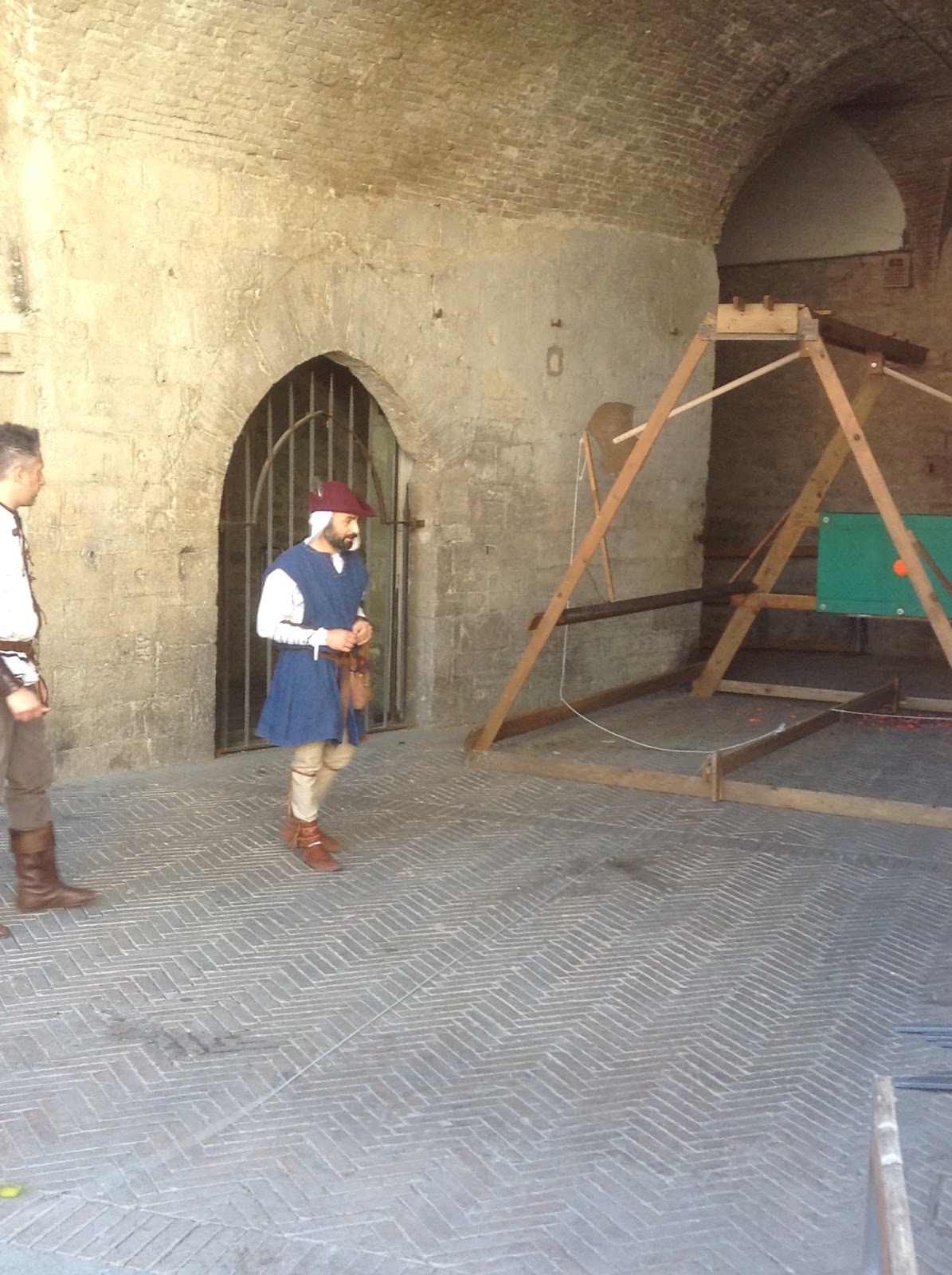
The highlight though was  the mid day archery competitions involving groups drawn from the four quarters of the town. Italian men and women do love to dress up and here was the perfect opportunity - outfits ranging from a knight in chain mail to a tonsured friar - both complete with bows and quivers of arrows. We couldn't help giggling at the some of these quasi-medieval outfits and the phrase "men in tights" couldn't have been more apt for this colourful display. In the main square the group were engaged in firing arrows through a makeshift swinging pendulum structure at the target behind and they were very skilled. The crown roared with approval when the bullseye was hit.

A TEAM BOWMAN FIRES AT A MOVING TARGET IN THE MAIN SQUARE
THE TARGET IS STRUCK THROUGH THE SWINGING PENDULUMS
OTHER COMPETITORS AWAIT THEIR TURN
Visiting these two Umbrian fiestas was an uplifting experience - a feast for all our senses and a reminder of the importance of cultural ritual based on history and tradition in these little towns. Not only do they bring the community together, young and old alike, they cement the present with the past and provide continuity in a rapidly changing world. At a time when modern technology and social media seem to be the principal reason for existence in the minds of many young people today - there was something ever so refreshing, heart warming and spiritually uplifting in these local fiesta events - long may they continue. As we walked back to the car we reflected on our perfect morning out and drove home looking forward to our well earned Sunday siesta? I wondered what the evening would hold later on??

Watch out for another posting related to Spello coming soon - its about a wonderful fresco cycle to be found in one of its churches by the renowned artist Pintoricchio.

Ciao & KBO
Ian