Tuesday, 28 March 2017

COSIMO DE MEDICI - MOVER AND SHAKER OF THE ITALIAN RENAISSANCE

COSIMO DE MEDICI - MOVER AND SHAKER OF THE ITALIAN RENAISSANCE AND A STUNNING BRONZE SCULPTURE.

In times gone by when I first showed an interest in the fine and decorative arts my studies concentrated on the 19th century in Europe and Britain in particular and I took little notice of the Renaissance period of the 15th and 16th centuries. My perceptions of the European world being one dominated largely by the church and its patronage with a legacy in our art galleries today of works with a religious subject matter was naive to say the least. Now its this very period that I find captivating and having the opportunity to visit Italy two or three times a year is just manna from heaven. So my posting today takes me once again to the Florence of the 15th century and introduces a man of extraordinary ability, capability and influence. Then it goes on to look at a work of art I've seen several times on my travels to Florence. It may have a religious subject, but as I intend to reveal here, it has a timeless value set firmly within a framework of Medici patronage and human achievement, creativity and excellence of a very special kind. It is quite simply both arrestingly beautiful and academically significant. Not surprisingly, in the history of western art books on the Renaissance always seem to give it special status.

Cosimo di Medici (1389-1464) is the man credited by many as establishing the illustrious Medici dynasty in 15th century Florence. His achievements were many. Firstly he further developed the banking network established by his father Giovanni di Bicci di Medici (1360-1429) and through this he amassed huge wealth and resources the size of which it would be difficult to envisage and comprehend even in today's avaricious world.  Secondly, by taking control of Florence's power bases and using them to enhance the family's status he quietly pushed his family in to pole position in such a way as to extend its influence throughout northern Italy and beyond. Thirdly, by pursuing a myriad of intellectual interests he became one of the movers and shakers of the Renaissance in Europe and deliberately created for himself a legacy which has lasted centuries.

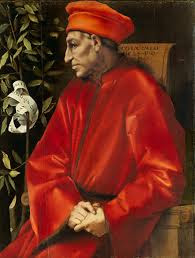
COSIMO DE MEDICI
by Jacopo Pontormo *
The laurel leaves, revealed in the background, became a symbol of the Medici family.
In 15th century Italy "humanism" was the slowly developing fashion for pursuing studies that illuminated understanding of the human condition and its potential - something very different to the Christian medieval view of a world where all was said to be controlled by divine forces and where everything was to do with the will of God. But in 15th century Italy the winds of change would blow strongly for it was a time of gradual but momentous intellectual revolution and rebirth. Cosimo de Medici would at the very heart of this new movement!

Initially the development of humanism was fuelled by the rediscovery of ancient classical literary sources - manuscripts which brought to life the works of Plato and many others. These had survived the "dark" ages in the libraries of monasteries in different parts of Europe and Byzantium and in the 15th century the mission was to discover and possess them. Cosimo, the fabulously wealthy Florentine banker, was able to fund a search for them and assist in those discovered being purchased and removed to Florence. Many of them would rest in his own personal library, but they were also studied seriously and often shared between scholars. Insights gained from them would profoundly influence the development of Florence in the 15th century - intellectually, politically, socially and in terms of the very fabric of the city itself through building commissions and art patronage.

To enlarge - by the time Cosimo was 30, from very small beginnings, he'd built up a collection of over 70 important books and manuscripts  He used an agent called Poggio Bracciolini as his intrepid scout and trips were made to many European cities as well as to places further afield in Greece, Syria and Egypt. Bracciolini had been letter writer to Pope John Paul XXIII and later became a major searcher of ancient manuscripts throughout Europe making trips to France, Germany and Switzerland. Not known for being the most scrupulous of negotiators he did however make an incredibly important find at the Monastery of St Galen in Switzerland where, in a tower dungeon, he uncovered a complete copy of DE RERUM NATURA "On the Nature of Things" written by Roman author and philospher Lucretius and lost since the fall of the Roman Empire. Based on poems by Greek authors it was to prove important in the development of early humanist thinking in 15th century Florence. Bracciolini would also prove influential in helping Cosimo realise his ambitions of becoming a major manuscript collector.

Sources also tell us Cosimo settled the debts of the eccentric dilettante and collector Niccolo de Niccoli after his death (he and Cosimo had been friends since his youth). The debt settlement was done on the basis he could gain control over Niccoli's huge ownership of over 800 important books and manuscripts. He would donate as much as half of these to a new project he started in Florence in the early 1440's.

 In 1444 Cosimo created the first public library in Europe in the Florentine monastery of San Marco - where he commissioned architect Michelozzo Michelozzi, a student of the illustrious Ghiberti, to oversee the restoration and development of a new Medici library there. The money provided by him funded not only the conservation and development work but in addition provided the funds needed to add more books to the ones donated from the Niccolo collection. Fortyfive copyists, hired by the bookseller Vespasiano da Bisticci, made further accurate copies of other important works to add to the collection.  It was ground breaking stuff.


TWO VIEWS OF THE MEDICI LIBRARY AT THE MONASTERY OF SAN MARCO
IN FLORENCE (open to the public)
Cosimo's patronage of architecture and the arts included the following:
  • The Palazzo Medici, the archetypal Florentine palazzo - designed by Michelozzo Michelozzi
  • The commissioning of the fabulous fresco cycle in the Magi Chapel by Benozzo Gonzoli (completed in 1461 - see blog posting number 3 done in 2015)
  • Completion of the dome of Santa Maria del Fiore by Brunelleschi. 
BRUNELLESCHI'S DOME ON THE CATHEDRAL OF SANTA MARIA DEL FIORE
Part of Cosimo di Medici's legacy to the city of Florence
And then there was the David sculpture!! - the work of art I set out to write about at the beginning of this posting!

This patinated bronze figure of David, of David and Goliath fame (Book of Samuel Ch 17), is housed in the Bargello - Florence's museum of sculpture which can be found in a monumental building, once a prison and located behind the Piazza della Signoria. It's a cast bronze figure modelled in the form of naked young man (apart from a brimmed hat and calf length boots), with hand on hip and with his other hand holding an over-sized sword - the one he used to slay the Philistine giant - Goliath. The deed has been done and his right foot rests on the large severed helmeted head of the giant. The figure has an enigmatic smile on his face.

"David" by Donatello - 1440's
Bargello Museum, Florence.
The bronze casting and craftsmanship is superb and the figure is famous for being, according to most art historians, the first free-standing, unsupported male nude to be cast in bronze since antiquity. Many art historians, (but not all it has to be said for the figure is undocumented) believe the figure was commissioned by Cosimo di Medici from the upcoming Florentine Renaissance sculptor Donatello who he knew well. The date is probably the 1440's and its thought to have been a private commission made to stand on a pedestal in the centre of the recently completed courtyard of the Palazzo Medici. The statue was certainly recorded as being there by Vasari in the 16th century. Though there is no paperwork to support this theory - the laurel band on David's head would suggest a Medici commission. The laurel was one of the personal emblems of the Medici as seen in the Pontormo painting shown earlier in this posting.

Rear view of the Donatello bronze "David"

The earlier marble "David" by Donatello completed in 1409 which is much stiffer
 and more 'gothic' in character than the one we have been looking at. 
The iconography of the statue is on one level obvious - the young hero of the Israelites has slayed the mighty giant of the Philistine army, but on another level it is enigmatic and controversial. This figure is realistic and in it Donatello has captured a slender, vulnerable and effeminate young man - not exactly an alpha male and a huge contrast with the "manliness" of Goliath as its revealed in the huge severed head. The youth has overcome the giant not through physical capacity and capability but by other means which art historians have speculated on for decades. One curious aspect of the composition is that David stands on one of the two wings found on the helmet of Goliath, but the other longer wing appears to work its way up David's right leg towards his groin. Was this then a a coded message of a homoerotic nature perhaps signifying the known homosexuality of the sculptor or is there a more subtle meaning to this enigmatic work? At the time the statue was made homosexual acts were criminal offences, though the practice was common amongst young men in a society where casual sexual acts with young women were off limits to most. Whatever the case - the statue would have been perceived then as edgy in nature I feel sure. As a sculpture of male figure however it shows a distinct shift in Donatello's work for he made two statues of David - the earlier one in marble - which somehow lacks realism and doesn't convey the emotion and personality of the later one.

As I said - this early "humanist" statue can be viewed in the Bargello, but there is a plaster cast copy in the Renaissance Cast Court at the Victoria and Albert Museum in London. It's surprisingly good.

This has been a fascinating post to put together and I've enjoyed doing it. It's once again revealed to me the importance and broad-ranging interests and ambitions of Cosimo di Medici as one of the most important movers and shakers of the early Renaissance in Florence.

Ciao and until next time
Ian

* - the Pontormo painting of Cosimo di Medici was done some 50 years after his death in 1464. According to one author it may have been made from sketches contemporary with Cosimo's life which have not survived. You can make up your own mind, as I have tried to do, what qualities of personality and emotion the artist has captured in the work.


Saturday, 18 March 2017

HANNIBAL IN UMBRIA - THE STORY OF A FAMOUS VICTORY

WHAT HAS HANNIBAL GOT TO DO WITH UMBRIA'S LAKE TRASIMENO??

During our recent week in Umbria it rained a lot causing us spend more time than usual indoors. On one particular wet afternoon I got out the collection of old DVD's to choose one to wile away the afternoon and came across "Gladiator" which I haven't watched since it first came out. The story was cliched and familiar but I remembered it as an entertaining film. Whilst watching some of the Coliseum enactments mention was made, by the Master of Ceremonies I think it was, of the famous battle between the Romans and the Carthaginians in 217BC - a battle that the Romans famously lost. I'd forgotten that it took place just a few kilometres away from where I was sitting watching the film. Though I wouldn't describe myself as an avid fan of Roman military history I decided it was time to go and see where the famous confrontation took place. We made a decision to go the next day if the weather held up.

The battle site is located near the present day town of Touro on the northern shores of Lake Trasimeno just a 30 minute drive from our place and though we'd circumnavigated Italy's third largest lake on several occasions, we'd never stopped to discover more of this famous battle which played such a significant part in the second Punic war. Just outside Touro there's a pull-off by the road which gives a great vantage point of where the battle was fought.

March 2017 - a look out spot for viewing part of the battle site of Lake Trasimeno
There were two Punic wars fought between the Romans and the Carthaginians during the period of the Roman Republic. In the first, which ended in 241BC, the Carthaginians lost Corsica, Sardinia and Sicily and many other smaller islands to the Romans, - an economically disastrous result for the North Africans. The Phoenician city of Carthage didn't fall to the Romans however and it was from this ancient north African city that military retaliation against the Roman Republic was planned.

First the Carthaginians expanded in to southern Spain, a move not initially opposed by the Romans; they had plenty on their hands at the time attempting to control the tribes in Gallic and Germanic Europe. The Carthaginians, led by Hannibal the son of Hamilcar Barca, one of the great military leaders in Carthage, then moved on the Spanish city of Sagunto. and under Hannibal's army largely destroyed it. When the Romans decreed the city should be turned over to them, this became the official reason for the start of a second Punic war in 219BC.

Artist's impression of Hannibal crossing the Alpes with his army
and a herd of elephants
Hannibal, a clever, shrewd and tenacious military leader and tactician, had experience  and a reputation for using complex, intelligent and unusual strategies to defeat enemies superior in numbers. He had the capacity to cleverly assess the strengths and weaknesses of an enemy and play to his own strengths - all tactics he would use in the Battle of Lake Trasimeno.

A marble bust reputedly of Hannibal discovered in Capua, Italy. 
Sources reveal he decided to approach Italy by land, rather than crossing the Thyrrenian Sea - believing he might be able to stir up trouble and gather support for the war en route. His journey actually began in 218BC with an army of 50,000 men, 9000 horses, and 37 elephants and his route would involve crossing the Pyrenees and the Alpes. Who hasn't heard the story of  Hannibal taking these mighty beasts over the snow capped mountains? Sadly - most of them appear to have been lost during the journey. He went on to defeat the Roman armies at  the two great battles of Ticino and Trebbia and after crossing the Apennines he finally ended up in the vicinity of Lake Trasimeno in Umbria where he knew he would have to face up to Roman armies under the command of Consul Caius Flaminius. He had already been defeated by Hannibal but had been shadowing the victor's path with his army for some time. He believed a victory here would bring him the support of the Etruscans and perhaps the opportunity to take on Rome itself.

Hannibal considered the natural shallow basin, entered by a narrow valley with hills on one side and close to the northern shores of the lake on the other, a suitable place for an ambush and hearing that Flaminius was following his tracks he made preparations for another battle. He set up camp on the shores of the lake and developed his strategy. Below the camp he placed his heavy infantry on the top of shallow hills. Above the camp - on the heavily wooded hillside close to the valley where the Romans would come he concealed his cavalry so they could cut off any Roman retreat. Other troops were posted at points overlooking the basin with orders to keep themselves concealed in the woods. In addition Hannibal ordered his soldiers to light camp fires on the hills close to Touro to convince the Romans that his forces were further away than they actually were. Hannibal had cleverly set up an ambush site where the Roman armies would be surrounded on all sides and not easily able to retreat in any direction. They would be forced up against the waters of the lake in fact where Hannibal figured they could be finished off.

The Roman approach is marked in red, Hannibal's positions in blue.
The battle took place on the morning of June 24th 217BC (April in the Julian calendar) and the Romans approached from the west in fog. When they entered the narrow valley and the ensuing shallow basin Hannibal gave his troops the order to attack and his forces came down on the Roman armies swiftly so they had no time to form up - forcing them to fight in chaotic fashion - something they were not used to having to do. They were soon driven back to the lake shores from which there was no escape or return. In a matter of four hours most of the Roman army was wiped out. 15,000 Roman soldiers, including their Consul leader, were killed. A local myth says that because of the field of blood the stream which flowed through the area was renamed Sanguineto - Blood River. It was a tremendous victory for Hannibal and the Carthaginians and caused chaos back in Rome. Though Hannibal would never manage to attack and take the eternal city, he would occupy much of Italy and be at war with the Romans for another fifteen years. Only then would he be recalled to Carthage to engage in battle with the Romans at what would become the battle of Zana where he would be defeated once and for all by Scipius Africanus.

Artist's impression of the defeat of Flaminius's army on the shores of Lake Trasimeno
Hannibal is considered by many authorities on Roman history "to have planned and executed one of the greatest ambushes in history". Quite simply he is revered as one of the best military commanders ever to have lived and his planning and tactical methods have been much studied down the centuries.

The tranquil shores of Lake Trasimeno - the site of the battle - in March 2017
Today, from various vantage points, its possible to see the shallow basin where the massacre of the Roman soldiers took place, but in the quiet cultivated landscape of today there's little in the way of tangible evidence to reinforce the story I've told. The reconstructive evidence has largely come from literary sources. The other complicating factor concerns the fact that there have been conflicting theories about where exactly the shore of the lake was at the time of the battle as Lake Trasimeno has expanded and contracted in size at various points in time. Despite the arguments and the holes in the evidence however, this place remains an important battle site in the history of the Roman Republic and its story a testament to a Carthaginian General who has entered the realms of myth and folklore. Google "Hannibal" and one discovers a whole list of references to films, drama series and documentaries based on the career of this most illustrious of military characters. To tell you the truth I knew little of Hanniabal (other than the story about the elephants) before doing the research for this blog posting. Now I know not only a bit about him, but also quite a lot about the Punic Wars and their importance in Roman history. I felt privileged to have visited this evocative historical site. What a wonderful retirement hobby blogging is - I can recommend it!!

THERE ARE OVER 90 POSTS MAKING UP THIS BLOG WRITTEN OVER SEVERAL YEARS - I HOPE YOU WILL TAKE A LOOK ATA SOME OF THE OTHER LISTINGS OR EVEN CONSIDER BECOMING A FOLLOWER THUS HELPING ME KEEP THIS BLOG ALIVE. CHEERS - IAN 


Friday, 10 March 2017

SAN GIMIGNANO - A TUSCAN TOWN WITH A PHALLUS COMPLEX?

SAN GIMIGNANO - THE TUSCAN MEDIEVAL TOWN OF THRUSTING TOWERS - WHO SAID SIZE DIDN'T MATTER?

It's been a while since my last post and I apologise for that, but now spring is here and hopefully its back to regular updates for my Italian blog. We've just had a short spring break in Umbria, but this time the weather wasn't good with lots of wind and rain. If the amount of rain that fell in the last few days is typical of this time of year, then there's no wonder they call the region "the green heart of Italy". On the day we arrived and on the day we were leaving however, the sun shone and the skies were the most amazing azure blue - a reminder that the local weather can be balmy even in March. This time we were flying home in the early evening from Pisa so we decided to leave Umbria mid morning and have lunch in one of our favourite Tuscan hill top towns - San Gimignano - just over an hour's drive from our place near Castiglione del Lago.

The route took us up the A1 motorway for a short while and then we turned left to head for Siena, by passing the town when we got there and taking the quieter road northwards in to the beautiful Tuscan countryside. Smoke was billowing from field fires in several places as owners pruned their olive trees and burnt the branches and there was much activity in many of the hillside vineyards as the plants were being prepared for the forthcoming spring growth surge. In this age of modern technology, where I was following our route as a blue dot passing along the route on my mobile phone, I celebrated that what I was seeing out of the window was a bucolic scene that had changed little over the last few hundred years. There's something very reassuring about that. It didn't seem long before we'd reached the brow of a hill and there in front of us, sitting on top of a fold in the landscape in the spring sunshine, was the  town of San Gimignano - renowned for its many tall towers and one of the most distinctive and famous skylines in the whole of Tuscany.


TWO VIEWS OF SAN GIMIGNANO
After driving up the narrow winding road to the town (goodness knows what its like in summer!) we parked the car in an ultramodern car park outside the city walls near the 13th century gateway - the Porta San Giovanni. Today, thankfully, only locals and delivery vehicles are allowed inside the walls during the day time. (One of my friends in the States told me recently she'd spent time in the town in 1982 whilst on honeymoon and driven through the gate all the way up to the main square where she and her husband had parked the car and then gone to find a room for the night!) No need to worry about being mown down by a Vespa on this occasion.

PORTA SAN GIOVANNI
Though the narrow main street is today lined with tourist shops selling artisan foods, ceramics and knick knacks - it's incredibly atmospheric and despite lots of visitors, even at this time of year, the experience is one of stepping back in time. It's easy to let the imagination run riot and think of the colourful hustle and bustle there would have been on a street like this in times gone by. Like many other hill top Tuscan towns - the route is a spinal one, gently leading up to the main square and as one passes along it, its possible to catch glimpses of the glorious Tuscan countryside through the narrow alleyways that lead off it on both sides of the street. I remembered to look out for the partially original 13th century Romanesque facade of the church of San Francesco on the right hand side.

FACADE OF THE FORMER CHURCH OF SAN FRANCESCO
At the top of the street we entered the picturesque Piazza Communale and stopped to catch our breath.
PIAZZA COMMUNALE WITH THE TOWERS
OF THE ARDINGHELLI FAMILY CLEARLY VISIBLE
San Gimignano can trace its origins back centuries and by the early medieval period it was already well fortified. It had flourished on the back of trade in saffron harvested from the brightly coloured crocuses grown in the local area. Its position on the Via Francinega from Rome at a point where it intersected with a road to Pisa was geographically a good one. Originally under the church's control it became a free commune in 1119 and for the next 200 years it grew and prospered until 1315 when the European pandemic of the Black Death, coupled with poor harvests and family feuds caused its growth to falter so it had to ask Florence to administer it in return for protection. The gradual decline in its prosperity over the ensuing centuries protected it from future development meaning that in the modern age the city street plan and much of the urban fabric largely remained unchanged. As visitors we benefit from this aspect of its history and today it is listed as a UNESCO World Heritage Site.

ANOTHER VIEW OF THE PIAZZA COMMUNALE
There are many Tuscan hill top towns with a similar urban plan to that of San Gimignano - Montepulciano comes to mind just along the road from where we have our place - but what on earth caused the explosion of tower building in this one? Well - it would appear that essentially it was a huge medieval willy-waggling competition. Local, wealthy families, often in conflict with one another in the town, flaunted their power and status through tower building. By the 14th century there were 72 towers would you believe, though only 16 are still standing today. The buildings from which the demolished towers sprang up are still there. Sources indicate that many of the towers were inhabited and had wooden balconies and outside landings with staircases down to the ground.The Rognossa tower in the main square, 51 metres tall, was one of the tallest and the site of the local administration in the medieval period.

THE INTERIOR OF OSTERIA SAN GIOVANNI
VIA SAN GIOVANNI
We spent lunch time in a wonderful little restaurant on the main street just below the square. We were the only people there and the pasta dishes - home made lasagna and a wild boar stew were beautifully served and delicious - not too bad on price either for a restaurant on the main tourist drag. Not surprisingly it was called Osteria San Giovanni and I would definitely recommend it. The second treat came shortly afterwards when we decided to have an ice cream before going back to the car. We retraced out steps through the Arch of the Becci (previously a gate in the original 10th century city walls) back in to the square and there, behind a narrow frontage, we rediscovered one of the best gelato shops in Italy - Gelateria Dondoli. The choice of flavours was a huge mouthwatering display and I chose a carton with a medley of three flavours, pistacchio, dark chocolate and pink prosecco, Jon had a cone with his two favourites on top - all for the  princely sum of 6 euros. The photographs speak for themselves. I'd return to San Gimignano anytime just to come to this little ice cream shop!


If you visit San Gimignano there's lots more to do than just wander the streets - though that in itself is a rewarding experience. Here are a few other suggestions:

Collegiata di Santa Maria Assunta - built in the 12th and 13th centuries - in the man square. Full of works of art including a fresco cycle telling the story of Santa Fina by the renowned Renaissance artist Ghirlandaio.
The Museum of Sacred Art - full of works from the collegiate and other local churches.
The Museum of San Gimignano which includes a large scale model of the medieval town.
The Palazzo Nuovo del Podesta - dating from the late 13th century, which includes the Torre Grossa - the highest tower in the town and the only one that can be visited. The palace includes the Museo Civico.
The church of Sant' Agostino which has a rather special cloister and an interior with lots of works of art.
CIAO FROM SAN GIMIGNANO
For us it was time to head off to Pisa for the early evening flight to Stanstead. So if you haven't been to San Gimignano - put it on your Italian bucket list - I don't think it will disappoint - whatever time of year you choose to go there.


Thursday, 3 November 2016

SIENA'S DUOMO - WALK ON THIS FLOOR AND PREPARE TO BE AMAZED!

Our first visit to Siena on Boxing Day 2011 took place on a dreary, rainy day and in the afternoon we were glad to take refuge inside one of its most important buildings - the Duomo. It may have been a short stop on a dark day, but it was a visit that re-ignited my interests in Italian architecture and art history and it was formative in getting us to talk about having a place in Italy we could use on a regular basis. We took a vow then to return to to the cathedral as soon as possible to explore its treasures in greater detail. Its been five years since we were there, but now we have our place in Umbria and this will hopefully be the first of many sojourns to see this iconic structure. I can foresee lots of day trips from Citta so we will have the luxury of focusing on one or two things at a time - by far the best way of getting to know a huge building like a cathedral in depth.

Siena's cathedral,which takes the form of a latin cross with a dome and tall bell tower, stands in a central position on one of the city's three ridges and from a distance its soaring structures dominate the skyline; we could clearly see the prominent bell tower from the vantage point of our hotel's terrace. Begun in round about 1230 it took getting on for 150 years to reach today's appearance. The site of the church has a sacred origin which goes way back in time and investigations over the years have shown there was an ancient temple here dedicated to the goddess Minerva. Following the fall of the Roman civilisation a small Christian church probably initially occupied the site, but that presumably expanded and became more important and in 1058 a Synod was held there which led to the election of Pope Nicholas II and the deposition of the anti-pope Benedict X. The rising importance of Siena as an important and wealthy trading centre no doubt led to the decision to convert the church in to something much bigger and more impressive in the early 13th century.

SIENA'S MAGNIFICENT MEDIEVAL DUOMO
WEST FRONT & BELL TOWER
I love visiting cathedrals for they are surely one of man's greatest achievements. This one, and its nearby neighbour in Orvieto, are two of the most splendid in the whole of Italy. Not only are they superb examples of a multitude of crafts being combined in to single endeavours, they are a reminder of the use of great wealth creation to satisfy the spiritual needs of humanity through the building of awesome places of worship. They were intended as earthly representations of the glories of heaven - truly different worlds to the one found in the streets of the cities and lands which surrounded them. They offered the populous a glimpse of the awesome power of God, the glories of heaven and often the path of damnation for those that sinned. As we made our way from the Siena Campo that sunny Saturday afternoon in early autumn, leaving the medieval domestic architectural achievements behind, it was a moving experience to step in to the cathedral square again and once more discover the extraordinary black and white striped marble monumental structure that forms the main body of this humongous church.

People often ask what the origins of the black and white humbug like striped appearance are and the most logical explanation seems to be its relationship to the black and white Balzana coat of arms of the city which dates back at least to the early 13th century.

Entire books have of course been written about this glorious building so what I can achieve in one tiny blog posting is of course minimal. I've therefore chosen to focus on just two features of it - one outside - the splendid west facade and one inside - the truly awesome marble floor of the nave. Together they encapsulate the glories of this fabulous cathedral church.

The beautiful front facade of the cathedral was constructed between 1284 and 1370 in white marble with contrasting elements in dark green/black and pink Siena marbles. Careful observation shows that initially it seems balanced and harmonious, but there are differences in form and detail between the lower and upper parts. This is due to the way the scheme for the frontage evolved.

SCULPTURES FROM THE WEST FRONT OF SIENA CATHEDRAL
BY UNKNOWN ARTISTS
Essentially the facade can be divided in to the two separate levels - the ground floor part and the area above it. In 1284 the Cistercian monks of Galgano called in renowned architect and sculptor Giovanni Pisano to plan and work on the front part of the church and it was he who initially designed the facade, but he only completed the ground floor section. Typically there is a grandTuscan Romanesque three arched ground floor entrance frontage, each portal with a pointed arch above it. The central one is capped by a bronze sun. At the doorway heads and on other pedestals, carved sculptural figures of prophets, philosophers and apostles, designed and sculpted by the master himself ornament the composition and the vertical columns between the doorways are also richly decorated with acanthus scrolls and other details. Pisano only worked on the front of the cathedral until 1296 when he suddenly left the city following arguments about the project with the cathedral elders. The lower section was finally completed by Camio di Crescentino.

The upper section of the facade is by another artist - Giovanni di Cecco and its elaborately decorated in a gothic style. Work largely followed Pisano's original designs with alterations - the inclusion of a rose window for example seems to be di Cecco's contribution. Work seems to have been interrupted around 1317 when the emphasis switched to the east facade and the consensus of opinion seems to be that the front was finally completed around 1365. The upper part is also more elaborate in its ornament than the lower Pisano part and appears to be influenced this time by the French gothic style and is finished in 3 points like the cathedral at Orvieto which must have acted as a prototype for this one as the facade there is slightly earlier in date. I found it interesting to discover that the height of the facade also had to be increased to accommodate a raising of the nave behind it. The rose window is surrounded by a border containing niches containing sculptures of church patriarchs, but this time they are by unknown sculptors. Finally, the colourful mosaics on the facade are not  medieval and were added in the 19th century. They were made in Venice in the late 1870's and the central one depicts the Coronation of the Virgin flanked by two others showing a Nativity and the Presentation of Mary to the Temple. It's also worth noting that the impressive bronze central doors are a recent addition replacing ones made of wood. They were added in 1946 near the end of the German occupation of Siena and were designed by Vico Consorti and cast by Enrico Manfini - they show scenes of the Glorification of the Virgin - the patron saint of the city of Siena. So, this great church frontage has essentially a medieval origin with some later additions, but the overall effect today is one of great intricacy, harmony and beauty. Stand back from it and it's overall composition is pleasing to the eye, focus on its details and it entices one to contemplate what's inside!

I promised to talk about the cathedral floor next and this might seem a strange choice of case study given I could have chosen to discuss a world famous pulpit which appears in many art history text books or perhaps I could also have selected the amazing Piccolomini library with its stunning fresco cycle but I rejected both of those in favour of the floor, the likes of which I have never seen before. Our friend from London, Peter, who visited the cathedral with us that Saturday afternoon, thought it to be the most amazing sight he saw in the whole of his ten day trip to Italy! What's also interesting is that we didn't see or notice it on our first visit and there's a specific reason for that - it wasn't visible on the day we were there in December 2015. The marble floor covers the entire internal area of the cathedral but for most of the year it's covered up for conservation reasons. Only in mid to late August are the covers taken off to reveal it in all its splendour and the window of opportunity to see it is not very long - they cover it again at the end of October.

THE CATHEDRAL FLOOR IS ONLY REVEALED AS A WHOLE
FROM LATE AUGUST TO LATE OCTOBER EACH YEAR 
The marble floor consists of 56 panels of various sizes, each with a decorative border and a subject represented within the frame. It took getting on for 200 years to complete and what fascinated me was that a close study of the panels in different parts of the cathedral was like looking at a history of Renaissance art. Whoever heard of a church floor telling such a tale? - but in terms of a history of techniques and of composition it makes for a fascinating study. The earliest panels have been attributed to  1369 - the latest - a composition in front of the alter from 1547. Subjects range from representations of Sibyls, Virtues and Allegories to Bible narratives. Some have been restored and even relaid but overall the originals are in remarkable condition and retain their original characteristics.

Thinking about the techniques used to make the floor panels first. The earliest panels the late 1300's show the use of a "sgraffito" technique to make them. This is where pieces of marble have been gouged with sharp instruments where these have then been filled with bitumen or black mineral pitch to effect the lines of a composition.

THE LIBYAN SIBYL
THIS PANEL DEMONSTRATES THE USE OF THE GRAFFITO TECHNIQUE
ON THE WHITE MARBLE OF THE FIGURE ALL AGAINST A BLACK
MARBLE BACKGROUND
One writer has described the results looking like a giant woodcut. A hundred years later and the techniques of panel making were much more sophisticated and elaborate producing very different finished results.Here the panels are more like marquetry work where subtly patterned coloured marbles have been inlaid in the white background producing a complex pictorial effect with light and shade effects giving the subjects depth and the three dimensional character of Renaissance paintings, A whole variety of artists have worked on the floor panels over the years - the first well known one being Domenico di Niccolo dei Cori, a famous sculptor who was in charge of work on the cathedral between 1413 and 1423.

THE "SLAUGHTER OF THE INNOCENTS FLOOR PANEL"
SIENA CATHEDRAL
One of the most famous panels in the sequence is "The Slaughter of the Innocents" which appears to have been laid in 1481 and was the work of Matteo di Giovanni. This tells the story from the New Testament of King Herod ordering the slaughter of all new born children in an attempt to make sure of the death of the new born messiah. I found looking at this very moving and on further observation marvelled at the way the artist craftsman was able to make figures look "realistic" and able to suggest depth to the composition through the use of architectural perspective in the background and on stairs.  truly remarkable achievement.

ONE OF HEROD'S SOLDIERS ATTACKS A WOMAN WITH A BABY
IN HER ARMS

DETAIL FROM THE ABOVE PANEL
SHOWING SLAUGHTERED BABIES ON A STAIRCASE
FOLLOWING HEROD'S MASSACRE
If you do visit Siena do try and go at the time of year when the cathedral floor is exposed for it truly is one of the best art historical things I've seen in ages - neither painting, nor sculpture but drawing on Renaissance developments in these areas. It's a fascinating exercise to trace the history of western art during the late 15th and 16th centuries by looking at a floor rather than at a series of paintings or pieces of sculpture. Put this wonderful floor on your Italian bucket list.

"THE WHEEL OF FORTUNE" LAID IN 1372

Well - that's it until next time.

CIAO AND KBO
IAN


Friday, 21 October 2016

SIENA & THE PALIO - WHAT A VENUE FOR A HORSE RACE - PART 2

Siena's annual Palio horse race is renowned throughout the world for its traditions and spectacle and people travel from the four corners of the globe to see it every year. It's not an event purely aimed at tourists though for its rites and rituals are deeply embedded in the history of the city and continue to play a role in defining the place that Siena is today - despite it being controversial to some.

I find it interesting how my present travels in Italy stir memories from life 20 or 30 years ago. I first came across it watching TV in the 1980's when chat show host Russell Harty did a Grand Tour of Italy and included Siena and the Palio as one of the venues and events to be filmed for the programme in the series focusing on Tuscany. I happened to know Russell then as we were both inhabitants of the small market town of Settle in the Yorkshire Dales. Russell was a frequent visitor to my Mum's antique shop. I remember talking to him about the Tuscany programme then and I found his description of the history of the Palio fascinating. Today I consider it a privilege to have been to see the place where it takes place and to be able to write about it in my blog.

"MR HARTY'S GRAND TOUR" 1988
Interestingly the book cover shows that chat show host
sitting in Siena's campo.
I have to confess though that I haven't seen the race first hand and what follows is an account of the event based on my experience of visiting the city a couple of .weeks ago, reviewing the race in U tube clips and doing some research. Sitting in the Campo, as we did a couple of weeks ago, fired my imagination and it wasn't difficult to imagine the atmosphere of the place on Palio day. I'm a bit saddened to also think that I won't be seeing it in the future either. The race takes place in the high summer when it can be very hot and the only place for unticketed members of the public to watch is from the cordoned off central part of the Campo. Any visitor wishing to be a spectator would have to turn up early and be prepared to probably stand for several hours before the evening race and there are no loos!! There are some tickets available every year for the banked seats round the edge of the race track, but I'm supposing its not easy to get hold of them. So - unless I'm invited to be a special guest by a group occupying one of the balconies or windows overlooking the square (I wish) the Cox presence will probably not be felt at the event. Awww - I can hear you saying!! I should mention though that the race itself is only a small part of the Palio experience and lots of preparatory rituals and pre-race events have to be gone through over several days prior to the race itself. So what exactly is the Palio and how did it originate?

Throughout Italy festivals rooted in sporting competition have played a significant part in community life for centuries. In Citta della Pieve in Umbria, the little hill top town where we have our apartment, there's an annual Palio held every August in which the town's Terzi compete with each other in an archery competition preceded by a grand procession through the town's narrow streets. The term "Palio" actually means "banner" - the trophy awarded in a competitive event. Such festivals must have provided an opportunity and an outlet for alpha males to bond together and collectively defeat opponents from a different part of town. In Siena, during the medieval period, "elmora" were popular. These were mock battles fought by teams of young men wearing light armour and carrying quarter staves. Usually it was the Terzo di Citta against the other two Terzi - the aim being to drive the other side out of the Campo. In 1263 records show that stone throwing had to be banned at these events and in 1291 ten men died at the elmora leading to its suppression and replacement with "pugna" - fist-fighting competitions. In the 14th century other types of event were recorded including one involving the contrade (districts) when 30 young men would try to get a donkey painted in the colours of a ward first round the Campo against the obstruction of the the other teams. These "asinate" or similar ones called "buffalate" involving buffalos, may have been the antecedents of what would evolve in to the Palio involving horses we know today.

What the precise origins of the Palio are remains a matter of conjecture. A Sienese palio is recorded as early as 1238, but it appears to have been a straightforward race between single owners and had nothing to do with the contrade. It was held outside the northern gate to the city and even foreigners were allowed to enter horses in the race. Later it was run inside the city walls on certain religious festival days and in a more or less straight line from the Porta Romana to the Duomo. Even then it was not run along contrade lines.

The modern day Palio probably began in the 17th century when horse races round the Campo were introduced with rules which allowed interference with competitors during the race, no use of  bloodstock and an element of pageantry to boot. This time it involved the various contrade entering horses and riders for the event and herein lies the origin of the modern race.

Seventeen contrade have survived in the city from originally a much larger number in the middle ages. We can think of them as city neighbourhoods and their boundaries were finally established by statute in 1729. Originally each probably had a militia drawn from the men in the community whose responsibilities involved patrolling the streets at night to help preserve law and order. As time passed these groupings were forged into fiercely independent, close-knit groups with clear identities within the larger city community. Each had a strong spirit of mutual aid (rather like a brotherhood) and each proudly took their civil responsibilities seriously. Competing with other contrade groups would have been a feature of life and a ritual like the emergent Palio would have been a perfect outlet for showing prowess in a competition with other contrade. Even today the Sienese are fiercely "contradaioli" (loyal residents of a contrada) first and Sienese second.

A VINTAGE SILK HEAD SCARF SHOWS THE COSTUMES AND FLAGS
OF THE VARIOUS SIENA CONTRADE WHICH COMPETE IN THE PALIO
Today the Palio is held in Siena twice a year - on July 2nd to commemorate the miracles of the Madonna of Provenzano and on August 16th to honour the assumption of the Virgin. Only 10 of the 17 contrade compete in each race through a rotation system linked to a lottery which takes place before each festival. Jockeys are selected by each contrade from a range of professional jockeys available and so each can become familiar with his horse and make a bond with it - 6 trial races take place in the campo - the last one on the morning of Palio day itself. The 5th trial is held the evening before the festival and is named the Prosa Generale (general trial) and after it each competing contrada holds an outside rousing celebratory dinner. Many spectators choose to watch one of the trials rather than the event itself.

EACH HORSE TAKING PART IN THE PALIO IS BLESSED IN THE CHURCH
OF THE CONTRADA IT REPRESENTS ON THE MORNING OF THE RACE
A number of important rituals take place on the day of each race. Each contrada takes its horse inside its own community church or chapel for a blessing ceremony with the local priest and the contrada members and tourists turn up to witness it. Also on the morning of the race, in the chapel next to the Palazzo Publico in the Campo, the Archbishop of Siena says a mass for the jockeys taking part in the race and the contrade captains all go to the town hall to register their horse and rider. During the day the atmosphere builds up in anticipation of the grand historical procession which begins at 5pm and lasts about an hour and a half.

BY 4PM THE CAMPO IS FULL AND THE CROWDS WAIT FOR
THE HISTORIC PROCESSION TO BEGIN AT 5PM
The historic procession, called the Passeggiatia Storica, is taken very seriously indeed and is well organized and rehearsed. The parade is colourful, vibrant and all of its participants are in historical costume. There are mace bearers, trumpeters, bandsmen, grooms. standard bearers and individuals who represent the traditional rulers of the city including the Podesta - the Captain of the People of Siena. Each contrada taking part in the race has the opportunity to present its credentials to the crowd through its 19 costumed members and though I'm amused by the commentator who described the event as being a bit like a traditional deck of cards come to life, it seems to be something much more significant than that. The costumes of each contrada are based on the colours of the standard and the flag is the keynote emblem of each one. The most spectacular part of the procession is the flag throwing when standard bearers from each contrade toss their flags and throw them in to the air in spectacular displays. A special award is made to the contrada who presents itself best in the procession and its a valued prize. As one commentator has put it - rivalries between different contrada are much more complex than they are say between two football teams from Manchester or two baseball teams from New York!

STANDARD BEARERS FROM THE "AQUILA" -
THE NOBLE EAGLE CONTRADA  WAVE THEIR FLAGS FOR THE CROWD
The procession ends with four white oxen pulling a cart in to the Campo on which the Palio - the standard that will be awarded to the winning horse and jockey representing one of the ten contrada taking part in the race.

THE CARROCIO EXHIBITS THE PALIO THAT WILL BE
AWARDED TO THE WINNING CONTRADA
After the parade the horses and jockeys enter the Campo and get ready for the race to begin. Nine of the horses will line up behind a rope and the tenth, chosen by ballot I think, will be the one that will have the power to start the race by galloping up to the rope and then the race begins and all hell breaks out.
THE RACE IN FULL SWING
The race is three circuits of the Campo and lasts only 90 seconds and there are some hair-raising parts of the track for the horses to negotiate; at one corner of the Campo for example there is a sharp downhill turn which is dangerous for all the competitors. During that brief 90 seconds, horses can stumble and fall, jockeys can be thrown and still the race continues apace until the winner crosses the finishing line and then its over. The winning horse and rider, swamped by supporters, will eventually make their way to the Duomo in the August race for a Te Deum service of celebration involving the Siena church hierarchy and the winning contrada members. In the evening there will be an open air banquet in the streets of the winning contrada.

Should one see the Palio? Well having described its historical and contemporary importance and its form and nature, I am persuaded that I would if I had the opportunity to see it from a good, safe vantage point. Horse lovers might think differently though so you might not wish to view the U tube video of the 2016 August race which is below


Who won the August 2016 Palio race then? Well it was won by the Lupa - the She-Wolf District whose church is St Rocco in the Via Vallerozzi.

Until next time
Ian